Highlights-
The Women Safety Accelerator Fund (WSAF) is a program that was initiated in 2021 to create a platform for women in the tea estates to identify the otherwise ‘normalized’ violence faced by them and express them in a platform. It also established the need to delve further into other aspects of women safety such as redressal of sexual harassment and domestic violence, creating a dialogue around sexual and reproductive health rights and also find solutions towards additional incomes and financial security. Continued efforts have focused on strengthening the approach around these thematics to ensure holistic development of the women workers in the tea sector of India and in turn ensuring safe, healthy and empowered tea communities.
Establishing Sexual and Reproductive Health Rights
Women still resort to using cloth during their menstrual cycle which may not always be hygienic. Some still disregard contraceptive methods thinking that it goes against the laws of nature. Quite a few of the tea estate hospitals are still not under the Public Private Partnership model leading to challenges in supplies. Some of the contraceptive methods may have certain mild side effects which becomes a concern for the people. People are ignorant regarding the prevalence and symptoms of UTI/ STI which mostly go untreated. Teenage pregnancies are significant in number.
At the onset, the tea estate managements had highlighted the need for modern methods of contraception to be introduced within the communities. The major challenge was in creating awareness among the communities around these taboo topics as there were traditional practices along with myths and misconceptions prevailing within the communities.
When we started our discussions centered around sexual and reproductive health, the people were initially shy and uncomfortable discussing such topics but fortunately open to it as they believed that it could bring about a positive change in society. The discussions turned out to be rather interesting with the men.
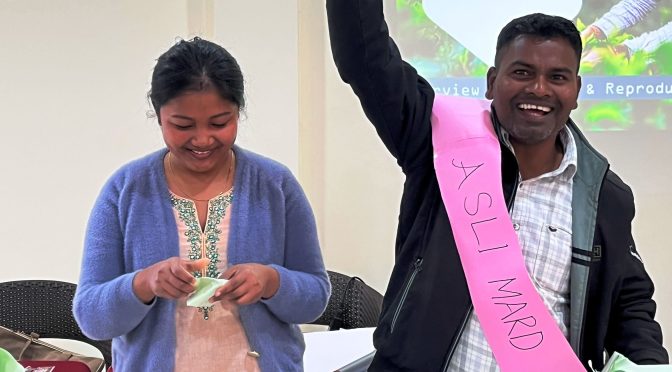
During one of the sessions, a line chowkidar (in charge of safety in the residential lines) was handed over a ‘secret’ pack. He was very happy to receive it and was asked to open the pack and reveal it to all those present. He enthusiastically opened the pack and showed it to all without realizing that it was a packet of sanitary pads. On being asked what it was and what it was used for, he felt shy to share the same. On being informed that menstruation was a natural phenomenon and the essence of creation and that it was a safe space to share his opinion, he felt comfortable to mention that it was used by the women in his household during the time of menstruation.
Exploring Avenues for Additional Income
Another angle which we explored during this year was trying to figure out additional livelihoods for the tea estate communities as their minimum wages were rather low. We had several rounds of discussions with the Assam State Rural Livelihood Mission to understand what could possibly work in the tea estates. Some of the ideas that were floated were that of kitchen gardens, organic manure and tea tourism. Groups needed to be created at the tea estate level and then trained accordingly to run the functions. The plan was to organize them into producer companies.
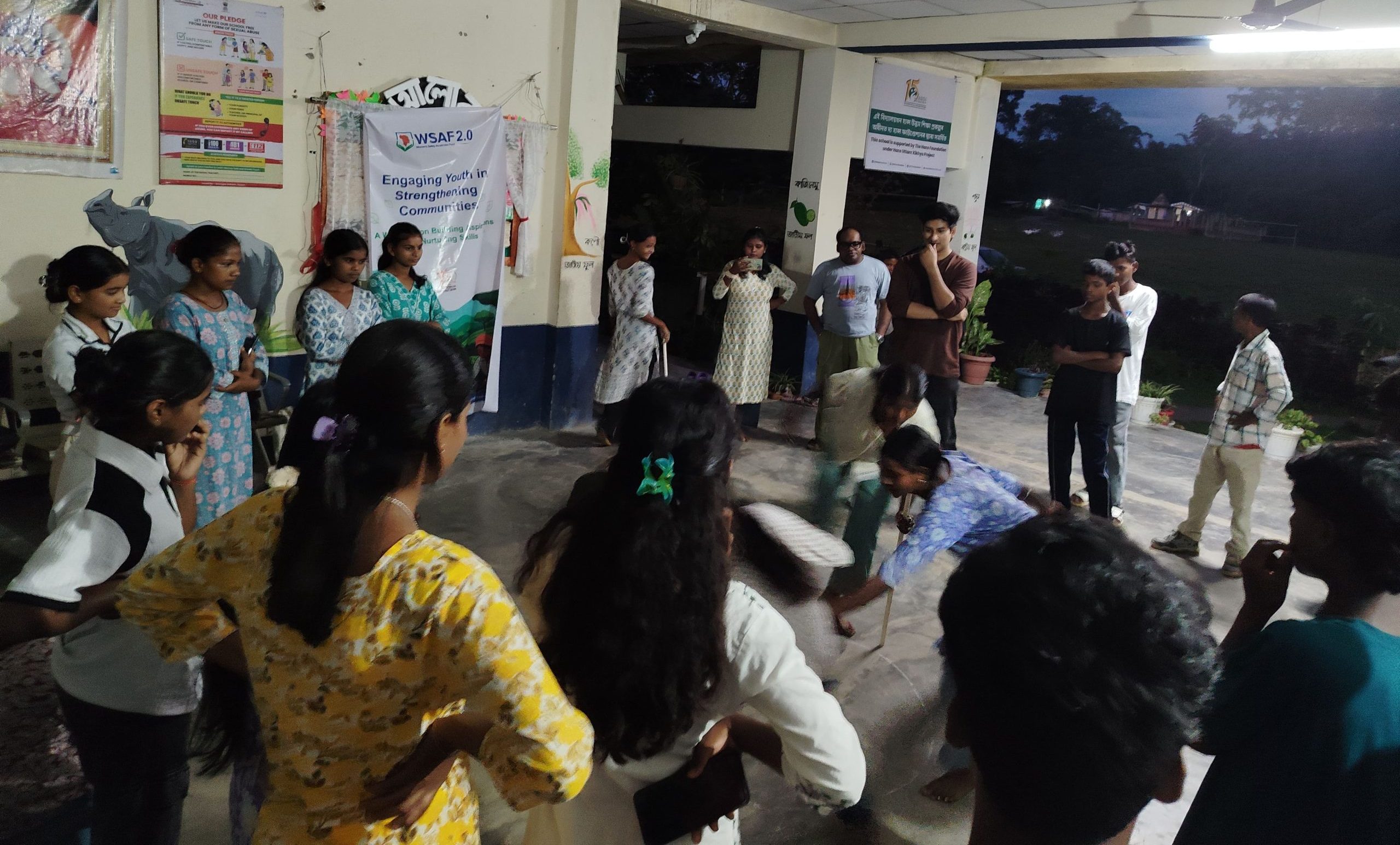
With this in mind, we organized several outreach programs in the tea estates to identify those interested to be part of such programs. We had expected a large turnout as we were offering opportunities for the unemployed youth. To our surprise, not too many people turned up. On being questioned about their aspirations, the youth were blank as to what they wanted to do. Infact, they did not have much interest to do anything.
We could thus infer that what was required was a large scale drive targeting youth to build aspirations and make them realize the importance of positive engagement and the need to earn a sufficient livelihood.
WSAF was conceptualized keeping in mind certain challenges faced by the tea community, but the long term engagement has given us the clarity on how to engage with communities to get the necessary outcome. The key lies in creating a platform for dialogue. Nothing can be imposed upon communities. There needs to be deep trust and strategies need to be evolved keeping in mind the need of the communities. The 5 years of engagement with WSAF has definitely given us the perspectives on the things to do for holistic development of the communities, the most important being tapping the potential of the youth to bring about the desired change and creating the necessary linkages with Govt. stakeholders. Continuous exchange of ideas with the community can definitely go a long way in creating the necessary exposure for the people to think of the larger good beyond their mundane day to day existence.
Author: Devdan Mookerjee
Related Blogs :

চা বাগানের মাঠে স্বপ্নের লড়াই ফুটবলে মেয়েদের আত্মবিশ্বাসের জয়
WHEN VOICES RISE, CHANGE FOLLOWS