Living Folk, Lasting Legacy: The Art and Artists of West Bengal’s Gombhira and Domni

Gombhira and Domni are two traditional performing art forms from Malda district in West Bengal, known for their sharp wit, lyrical dialogues, and deep social relevance. 

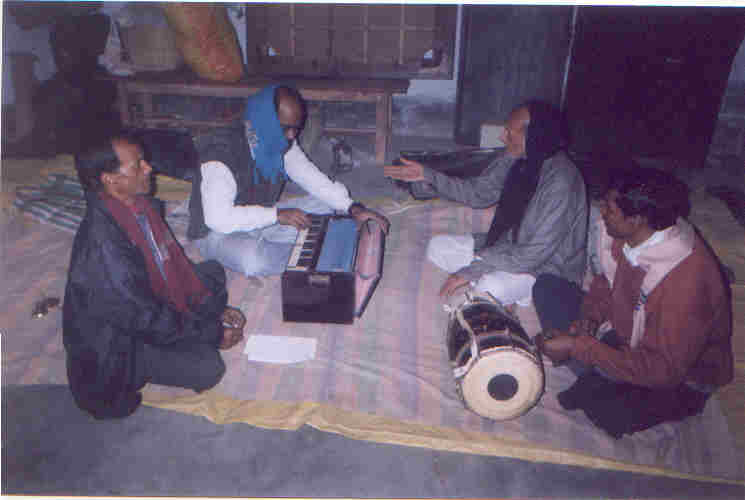
Gombhira, rooted in the cultural fabric of North Bengal, especially in Malda and Chapai Nawabganj (now in Bangladesh), is a folk theatre form usually performed during the Hindu month of Chaitra, coinciding with the Gajan festival. Performed through engaging conversations between a grandfather (Nana) and grandson (Nati), Gombhira uses satirical dialogues, songs, and dramatic storytelling to raise awareness about pressing social, political, and environmental issues.

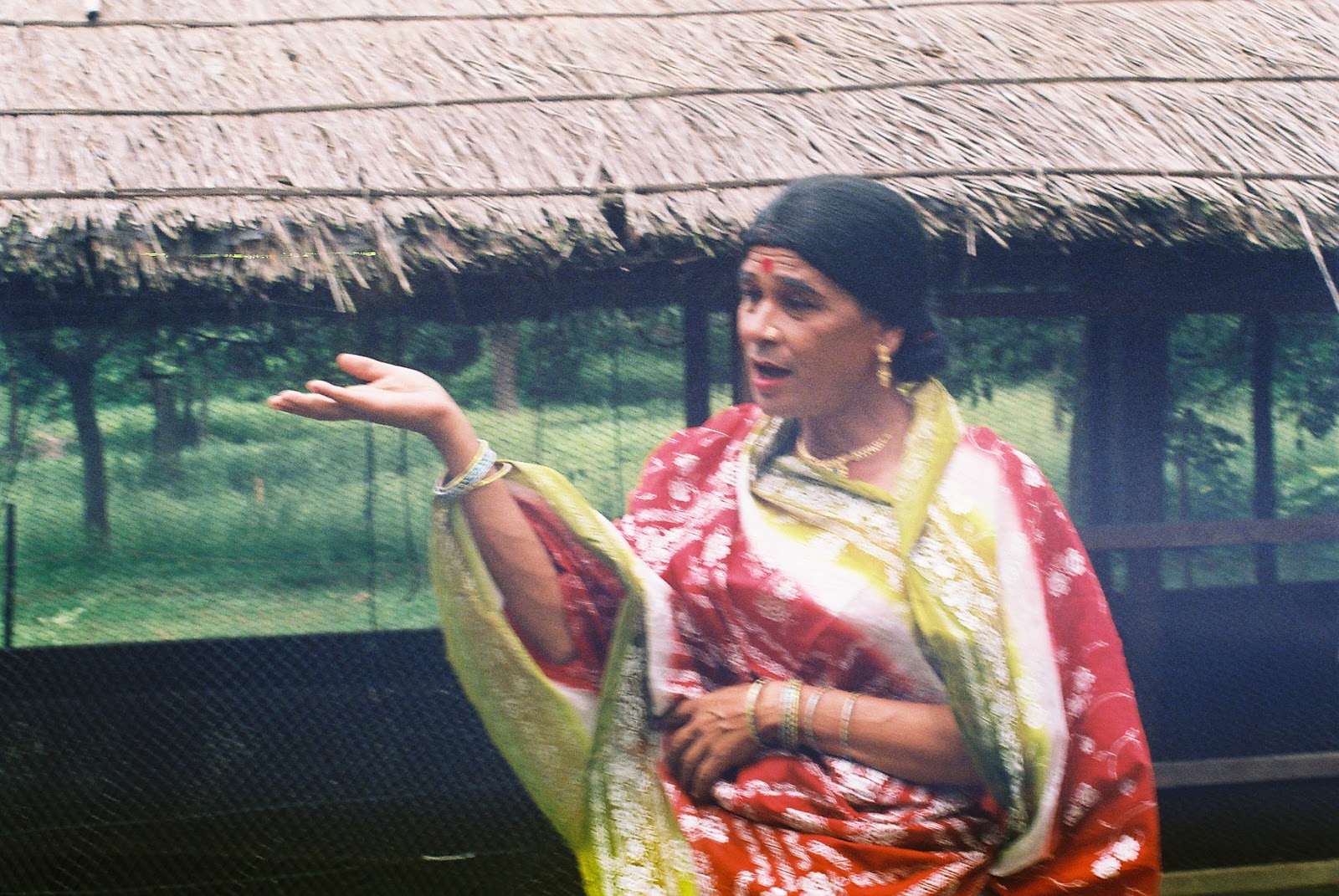
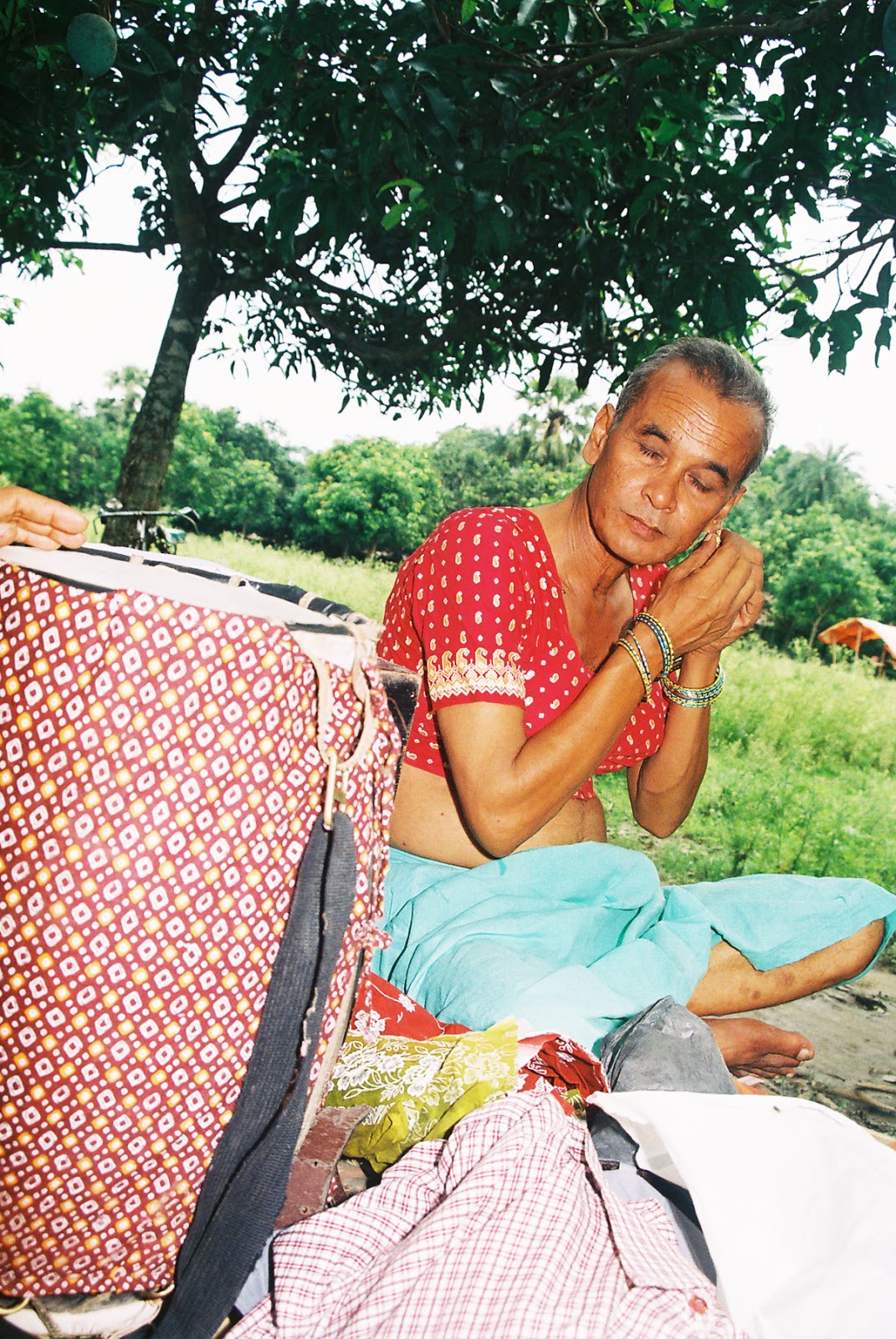
Domni, another rich folk theatre form, is popular in the north-western parts of Malda, bordering Bihar. It draws inspiration from tribal mythology, especially from the Santhal and Munda communities, and is performed entirely by male artists, many of whom portray female characters with remarkable authenticity. Domni is characterized by its absence of a written script, reliance on improvisation, and its use of the local ‘Khottai’ dialect—a fascinating blend of Bengali, Bhojpuri, Maithili, and Urdu.

At the heart of these traditions are the Gurus—masters of the art—whose passion and creativity revived and sustained these performance forms through changing times. Among them, three legendary figures—Dokori Chowdhury, Jiten Rabidas, and Bimal Gupta—played pivotal roles in this cultural resurgence. Though no longer with us, their contributions continue to inspire generations.

Dokori Chowdhury – The Soulful Lyricist of Gombhira

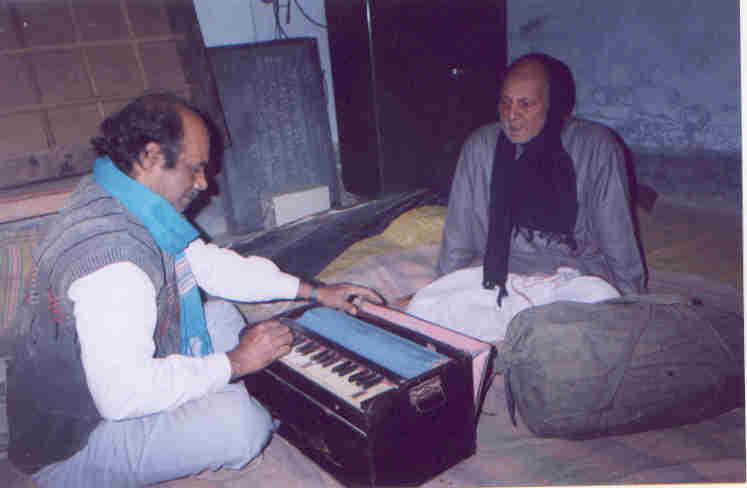
Songs and dialogues are the lifeblood of Gombhira, and lyricists breathe soul into this dynamic art form. Among them, Dokori Chowdhury holds a place of pride. A gifted singer and lyricist, he inherited the legacy of legendary performers Jogendra Chowdhury (Mator) and Debnath Ray (Habla), and carried it forward with sincerity and brilliance.

A resident of Bnashkori village in Englishbazar, Malda, Dokori joined Jogendranath Chowdhury’s troupe in 1965. He soon became the group’s lead lyricist alongside Debnath Roy. His verses resonated deeply across Bengal, combining humor and sharp critique to reflect everyday struggles.

One such verse:

“Ki khabite bohin pakka aam,
Dhuya rakh Suyader chopakhan,
Hamre Maldor lok gilchiye dhok,
Bish taka killo aamer dam.”

Dokori transformed Gombhira into a vehicle for social protest, using his lyrics to question injustice and corruption. His ability to make Gombhira contemporary while retaining its traditional essence was remarkable. In recognition of his contributions, he received the Lalon Puraskar.

In 2005, he actively participated in a workshop organized by banglanatak dot com at EZCC, where he expressed his vision through a beautiful song:

“Dibe ar nibe milibe melabe,
Etai moder asha,
Tai karmashalae asha,
Shilpi bachle, shilpo bachbe,
Bhalobashar bhasa,
Etai pratyasha.”

Dokori Chowdhury passed away on February 2, 2009, but his songs continue to echo in the hearts of Gombhira lovers.

Jiten Rabidas – The Master of Domni

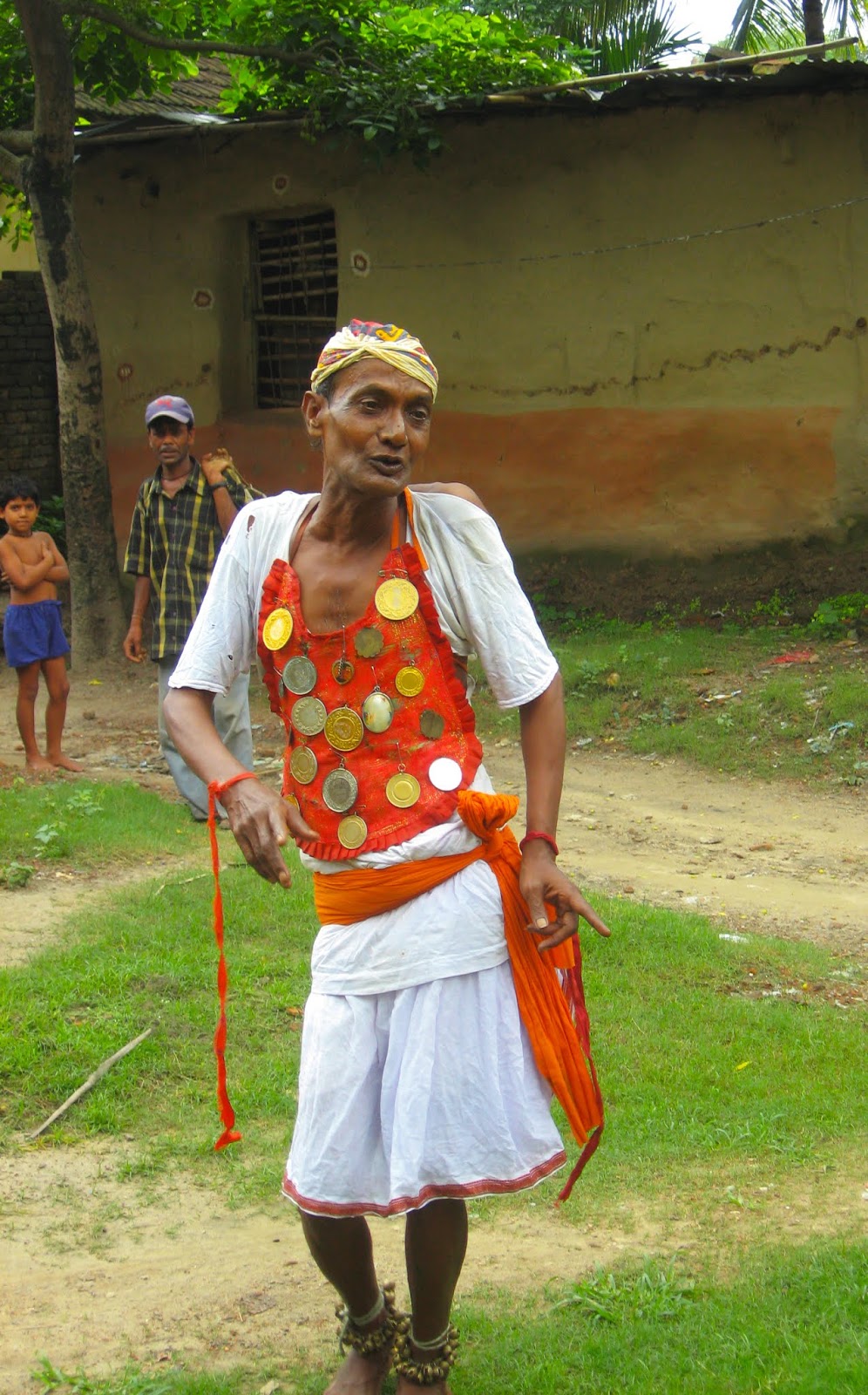
Renowned for his seamless portrayal of female characters, Jiten Rabidas was a celebrated Domni artist from Malda. Domni, popular in Ratua, Manikchak, and Harishchandrapur blocks, is believed to have evolved from the mythical journey of Behula, disguised as Dom Rani, and carries strong tribal influences.

Performing in the hybrid dialect of ‘Khottai’,  Jiten was not only a skilled actor but also an accomplished singer and dancer. His mentor was the eminent folk art specialist Subodh Chowdhury, under whose guidance Jiten refined his craft.

Jiten was closely associated with Loukik Srijani, a well-known Domni troupe in Malda, and performed across Kolkata, 

Cooch Behar, and Malda, earning admiration for his authenticity and emotive performances.

Despite his fame, he struggled with poverty, at one point surviving by selling lottery tickets. Yet, his dedication to his art never wavered. He remained closely connected with Sudhi Pradhan, a noted folk theorist who recognized Jiten’s talent. Jiten Rabidas passed away on February 10, 2019, leaving behind a legacy of resilience and artistic excellence.

Bimal Gupta – The Torchbearer of Gombhira

A celebrated figure in the world of Gombhira, Bimal Gupta was known for his powerful stage presence and razor-sharp wit. He mastered the form’s unique format—anchored around satirical dialogues between the characters of ‘Nana’ and ‘Nati’, often presenting their grievances to the deity Shiva.

Bimal Gupta’s greatest strength was his spontaneity. His quick-witted replies and engaging style brought laughter and reflection to audiences across Bengal and beyond. His performances captured the pulse of rural life, critiquing societal flaws with humor and compassion.

After the passing of Dokori Chowdhury, Bimal emerged as a key figure in preserving and promoting Gombhira. He worked tirelessly to involve the younger generation, ensuring that the tradition did not fade away. Bimal Gupta passed away on January 9, 2011, but his contributions continue to shape the contemporary practice of Gombhira.

Conclusion

The legacy of Dokori Chowdhury, Jiten Rabidas, and Bimal Gupta stands as a testament to the power of folk art as a medium of social change and cultural identity. Through their lives, these Gurus preserved, enriched, and passed on the vibrant traditions of Gombhira and Domni, ensuring that rural Bengal’s voice continues to be heard in powerful, poetic, and poignant ways.

Celebrating the Legends of Chau and Jhumur: Guardians of Bengal’s Folk Heritage

Folk traditions like Chau and Jhumur are not merely performance forms; they are living cultural expressions that weave together myth, memory, identity, and everyday life. Rooted in the soil of Purulia and surrounding regions, Chau is a vigorous, martial masked dance theatre form known for its stylized storytelling, athletic choreography, and elaborate masks. Three regional styles—Purulia, Mayurbhanj, and Seraikella—come together in Chau, with Purulia Chau being the most widely performed in West Bengal.

Jhumur, on the other hand, is the poetic soul of rural Bengal. It is a folk song tradition echoing love, nature, philosophy, and social realities—often performed with dance, but equally evocative when sung alone. Jhumur reflects the emotional and spiritual landscape of the community it belongs to.

The richness of these traditions has been preserved and advanced by generations of dedicated artistes. Among them stand three towering figures—Nepal Mahato, Mihirlal Singh Deo, and Salabat Mahato—whose lives were devoted to the revival, expansion, and safeguarding of Chau and Jhumur.

Nepal Mahato: The Global Voice of Chau

After the legendary Gambhir Singh Mura, Nepal Mahato emerged as one of the most iconic figures in the Chau tradition. Born on 17 June 1954 in Abadan village of Purulia, Nepal Mahato was not just an artist, but a Guru and visionary. Trained in all three forms—Purulia, Mayurbhanj, and Seraikella—his early exposure to Chau came during his school years at Shikshashatra High School, under his first Guru, Anil Mahato.

His artistic journey blossomed under the guidance of cultural patrons like Ajit Mitra and Dulal Chowdhury, leading him to form his own troupe in 1975. A major milestone came in 1980, when his troupe won a prestigious competition organised by the Academy of Folklore. His international debut followed soon after, with a landmark performance in London in 1982, making him the second global ambassador of Chau after Gambhir Singh Mura.

In 1983, Nepal Mahato was honoured with the Padma Shri for his role in protecting the authenticity of Chau and opposing its distortion. He performed in countries like Sweden, Canada, France, and Switzerland, captivating global audiences with the fierce beauty of Chau.

To ensure the continuity of this tradition, he founded a Chau Training Centre in his village in 1982, where he trained over 500 artists. In 1994, he took on the role of Supervisor at the Dr. Ambedkar Folk Art Fellowship, further solidifying his contribution to the cultural ecosystem.

Nepal Mahato passed away on 16 March 2019 in Cuttack at the age of 66. His legacy lives on through his students, his centre, and the cultural bridges he built across the world.

Mihirlal Singh Deo: The Modern Saint of Jhumur

A pioneer in the popularisation of Jhumur songs beyond Purulia, Mihirlal Singh Deo was born in 1939 into a Zamindar family in Rajnawagarh under the Kenda police station. Though trained in classical music—an artistic tradition in his family—he defied convention by embracing the folk form of Jhumur, guided by the renowned artist Ramkrishna Ganguly.

Mihirlal played a pivotal role in reviving solo Jhumur singing, proving that the form could stand powerfully even without dance accompaniment. His deep voice, lyrical sensitivity, and contemporary themes made Jhumur relatable to new generations. His compositions ranged from spiritual tales of Radha-Krishna to environmental and social themes.

One such song, rooted in environmental consciousness, goes:

“Jal batash mati kono na rohilo khati, poribeshe dhorilo bhangon…
Bhumisantan tomrai paro prakriti ke roksha koro.”

Another reflected on the devastation caused by elephants in tribal villages—blending folklore with realism.

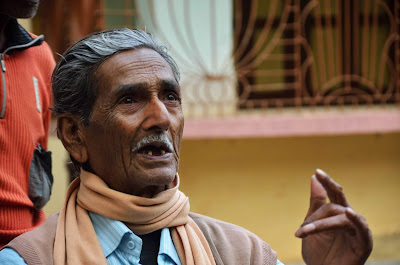
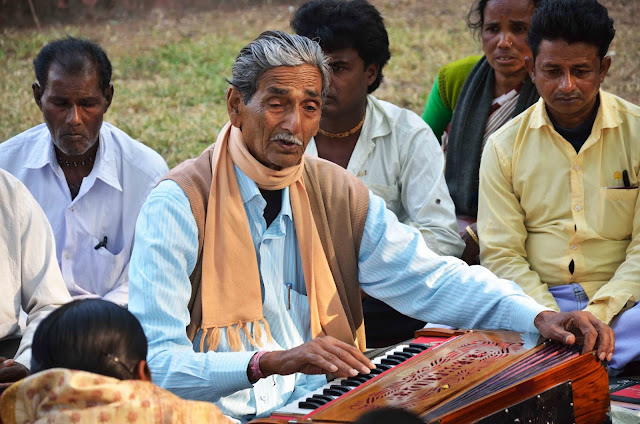
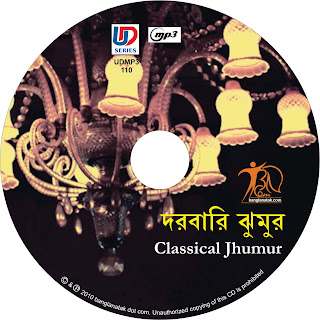
Celebrated by stalwarts including Pandit Ravi Shankar, Mihirlal’s musical influence was far-reaching. In 2010, he collaborated with Salabat Mahato and Amulya Kumar on the album Darbari Jhumur, released by BNC Musical.

He passed away on 18 January 2018, leaving behind a renewed, reimagined Jhumur tradition that continues to inspire.

Salabat Mahato: The Torchbearer of Jhumur’s Originality

Salabat Mahato was both a Guru and a guardian of Jhumur’s authenticity in the modern era. Born into a humble farming family in Latpada village under Barabazar police station, Salabat was a gifted lyricist, composer, and singer whose influence reached far beyond Purulia.

He is credited with reviving and preserving the purity of Jhumur across Bengal, Bihar, Jharkhand, and Odisha, at a time when folk traditions were being diluted or forgotten. Salabat composed songs rich in both lyrical depth and rural wisdom. Some of his notable lines include:

“Chander gayete kalanka roeche, tobu loke chand here go,
Premer majhete biraha roeche, tobu kano prem kore go.”

And also:

“Asha jawa bhaber khela, arai diner tore mela he,
Keu baa bar kore ninde, keu ba ador kore he.”

Salabat’s repertoire also reflected Baul philosophy, transcending the limits of one genre. His contributions earned him accolades like the Abbasuddin Award and the Lalon Award from the Government of West Bengal. A short film was made on his life and work, attesting to his stature in the cultural world.

He passed away on 9 January 2017, but his songs and teachings continue to inspire folk musicians and enthusiasts.

Legacy in Collaboration

In 2010, three legends—Salabat Mahato, Mihirlal Singh Deo, and Amulya Kumar—came together to record the seminal album Darbari Jhumur, a landmark contribution to the preservation and dissemination of authentic Jhumur songs. This collaboration marked a confluence of deep-rooted tradition and visionary artistry.


Music for Development

India is extremely rich in traditional cultural art forms that have centuries old history and tradition. Folk music is integral to the lifestyle and living of the artists. Realizing the overarching potential of music in bringing about social, economic, cultural empowerment of indigenous communities, as well as inclusive growth, banglanatak dot com has been working with music as a driver of sustainable development. Banglanatak started working with music as part of its ‘Art for Life’ programme that commenced as a pilot project in 2005, and have evolved into a proven model demonstrating how culture can be used as a resource for pro-poor growth, and sustainable development of rural traditional artists, and build resilient communities. Banglanatak has organized its activities, outputs and outcomes in terms economic, social and cultural impacts, along with its vision for ‘Music and Development’ through its division of MusiCal – an initiative to foster music entrepreneurship, social well-being, universal values and human rights based on the principle that music is a cornerstone of universal development.

West Bengal in eastern part of India is very rich in its diverse genres of folk music integral to the lifestyles of many traditional rural communities. Among them are Baul-Fakiri, Bhawaiya, Bhatiyali, Jhumur. Though these music have been popularised by renowned singers and musicians through the entertainment industry, the economic and social returns from the musical products have not benefitted the traditional practitioners directly. To address the challenges, banglanatak undertook a multi-pronged approach aiming to revive and revitalize musical traditions of rural Bengal.

Guru Sishya Parampara or teacher-disciple method of learning was emphasized upon while energizing continuity of authentic music traditions for renewed market opportunities Between 2006 to 2019 BNC revived the traditional community-based teaching methods and rejuvenated folk music traditions andsystematic practice and transmission of skills within the rural artist communities. https://youtu.be/hT1zRlTD7Tw

In addition to the inherent quality of music, singers and instrumentalists, a range of allied skills are required to make a mark in the highly competitive world music industry. Banglanatak undertook not only a behavioural intervention but also an international festival-oriented training intervention with flexibility keeping the nature and lifestyle in mind using various methods including showing videos of their master singers at international platforms and interactions of other stalwarts with global players.

User comments

The capacitated folk artists were directly linked to festivals, events, networks, etc. to open up multiple avenues of local, national and international market opportunities. The process facilitated not only professional performances but also exposure, knowledge exchange, understanding different types of audiences and different formats of presentations, etc. It also inspired aspiration among the previously marginalized singers and musicians, especially the youth, to undertake their traditional folk music as a professional career option.  https://youtu.be/k04j_OqitmE

To create international opportunity, banglanatak promoted these art forms at different international platforms through participation in festivals and events, and creating its own international festival and collaboration spaces. Since 2014 these musical forms have been promoted at WOMEX with a dedicated business stand for linkages with various music industry stakeholders and actors.

Folk music of different genres represent a rich storehouse of folk stories, diverse melodies, themes, song structures, instruments, and community practices that add to the intrinsic value of such music. However, either such knowledge is not documented or is held with specialized institutions engaged in research or archiving. Owing to lack of public knowledge of these music genres, and about the original artists, there is rampant commercial exploitation of these musicians and their creativity by the organized entertainment industry.

Today’s globalized world brings the advantage of digital connectivity and its immense potential to expand outreach across borders, promote musical products and their creators, and establish direct linkages and interaction with audiences, fellow musicians, industry stakeholders, etc. However, there are also challenges of remoteness of the rural singers and a huge digital divide that jeopardizes their growth. Banglanatak has systematically developed and archived digital information about these folk music genres, their artists, cultures, histories, etc., which are freely accessible online. https://youtu.be/8EmDHxKeqDw

Cultural tourism is widely accepted as an immensely potential industry to alleviate poverty, reduce migration and generate equitable growth for the local artist communities. Looking at the potential of cultural tourism as a major driver of grassroots economic, cultural and social development, banglanatak in 2009 started a new vertical of community-led cultural tourism within the larger framework of sustainable and inclusive development. Music community rural hubs were transformed into music tourism destinations in West Bengal. Today, these music villages are popular destinations for music lovers, musicians, and visitors at large. Community organized village festivals have been an important element in promoting rural cultural tourism.  https://youtu.be/ToDlTMeTqiA

Protecting IPR of musicians is a major concern of the industry. In a country like India, where enforcement of regulations on IPR is weak even in the organized industry, it is very difficult to protect the creations of traditional rural musician communities who are unaware of their own rights, and lack capacities to negotiate and fight for fair returns. To address the challenges of misappropriation of traditional musical assets banglanatak worked on empowering the artists of their own rights and developing their negotiation capacities. The community’s authentic musical heritage have also been recorded in audio and video formats directly by the traditional singers and musicians, and have also been published through music apps, CDs, Youtube, etc. with names and locations of these artists, under the Creative Commons license. 

Community development and creation of decent livelihoods through traditional skills of music generated economic resources, social cohesion, and a sense of identity and pride for the musicians. The collective community experience of economic, social and cultural empowerment, national and international exposure, growing performance opportunities and increased appreciation created a shared sense of purpose and value. The previously unknown and marginalized villages transformed into well known musical hubs of talented and respected musicians. This transformation led to a sense of collective well-being, social inclusion, and mutual solidarity.

The foundational principle of banglanatak is creating opportunities and access to resources for all, to ensure that every individual or social group can have the same possibilities and opportunities to fulfil themselves. banglanatak has tried to create a level playing field for the cultural practitioners so that they can grow and realize their full potential in an autonomous way, as well as enjoy human rights and dignity fully. Focused and strategic approaches were undertaken to ensure inclusion of women in the entire development process. https://youtu.be/JcApGhDWdeE

Dominant values and cultures have always existed and pushed against indigenous, and non-mainstream cultures leading to a more conservative and authoritarian society. However, folk music has always been the vehicle of ideas and expressions of pluralism, universal love and celebration of humanity. BNC’s work with folk music genres and the rural indigenous musician communities addressed their existing cultural marginalization along with social and economic ostracization. With the aim to promote cultural diversity and pluralism, banglanatak advocated for the vision of cultural democracy through widespread folk performances of the artists at local, national and international platforms, exchange and collaboration with different music genres and folk cultures from around the world, popularising their songs, tunes, instruments through social media and digital tools, and educating the mass audience on the openness, syncretism and richness of these music traditions. Sur Jahan, celebrating diversity, pluralism and openness, was conceived in 2009 and its first edition was organized in 2011 in partnership with various international embassies. The resulting event was unique because it was free for all and it provided an unconditional and unrestrained space for performers, musicians, and audiences to interact with each other, know about respective cultures and musical traditions, jam together and enjoy the diversity and confluence of creativity in one place. https://youtu.be/bvbvJkNc2Rc

Authors : Dr. Madhura Dutta & Debalina Bhowmick

Culture at a Click

Culture at a Click: Banglanatak dot com in partnership with Google Arts & Culture launches online exhibits on Bengal Patachitra and Purulia Chau.

We are a social enterprise working for the safeguarding and revitalization of traditional art forms for more than 15 years. Our flagship initiative Art for Life (AFL) builds sustainable eco systems for community led safeguarding of Intangible Cultural Heritage. AFL promotes Village, Artist, and Art together and has evolved the process of art and culture led rural development.

Our repository has images, videos and well researched stories of performing art and craft traditions across India. We are partnering with Google Arts & Culture to share about the intangible cultural heritage of diverse communities across India with over 250 visuals on the crafts and performing arts of Bengal from our archives that can be viewed online by people around the world. And there can be no better partner than Google Arts & Culture for this virtual exhibition.

Google Arts & Culture is the online platform to explore art, history and the wonders of the world in an immersive manner, all with just a click on your phone or computer. They develop technologies that help preserve and share culture and allow curators to create engaging exhibitions online and offline, inside museums. The Google Arts & Culture app is free and available online for iOS and Android.

Short summaries of our stories

Goddess Kali: The Transcendent Deity

https://artsandculture.google.com/story/1QXhmksCMSHqpA?hl=en

Goddess Kali is widely worshipped during Diwali in the Eastern region of India. Kali has been diversely represented in the different art forms of India; the diverse representation reminds us of the myriad socio-cultural fabric of our country. Sometimes Kali is represented as a fierce warrior and sometimes as a loving mother. Alongside being the Goddess of darkness, destruction, and death, Kali is also a symbol of Mother Nature because she is believed to be timeless and formless, representing the creation of life and the universe as well. Through our exhibit on Kali we have tried to capture this depiction of Kali and also the iconography behind the images. The iconography has been presented with significance of the images of Kali- the dark skin, weapons in her hand, her tongue sticking out, her mount-fox. The rituals involving Goddess Kali in art forms like Gomira and Sholacraft of Dinajpur districts in West Bengal have also been lucidly incorporated to make the story more informative and appealing.

Diwali: Celebration of Light and Hope

https://artsandculture.google.com/story/6wURs_CpTpbeGg?hl=en

The exhibit on Diwali perfectly captures the festive mood. Goddess Lakshmi, the Goddess of wealth and prosperity is worshipped on Diwali and that has been beautifully portrayed in the story with art forms like Patachitra, Dokra and Wooden Doll of Bengal. Lighting up homes and hearts of Indians, Diwali is a celebration of the triumph of light over darkness and is known for heralding positive beginnings. To symbolize the victory of light over darkness, good over evil and knowledge over ignorance, lighting of lamps is a common practice in Diwali.That makes it a festival of lights, and beautiful handcrafted lamps adorn Indian homes during this time. The exhibit shows some of the intricately handcrafted diyar by the Dokra artists of Bikna. One can also find eco-friendly options of lights like Terracotta, Sholacraft which are not only beautiful but also environment conscious option.

Durga in Bengal Patachitra

https://artsandculture.google.com/story/GwWRMLuOLSz37Q?hl=en

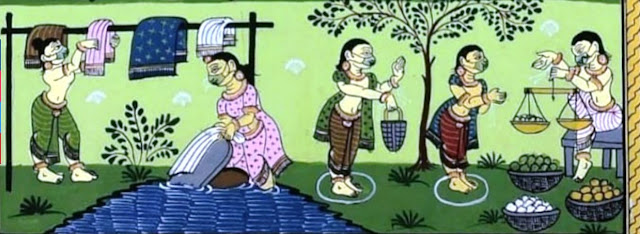
Patachitra is a unique storytelling tradition of Bengal where the artists known as  Patuas paint stories on long scrolls and narrate these stories in the form of a song. Goddess Durga, the most popular local deity is an important subject of their composition. The exhibit showcases how Patuas of Naya village of Paschim Medinipur district of West Bengal depict the story of Goddess Durga. In the exhibit one can see some beautiful Patachitra paintings of Durga as represented by the Patuas. It is interesting to notice the diverse representation of Durga by the artists, some portray Durga as a Goddess combatting the evil forces and some depict the Goddess as a loving mother.

Patachitra in Durga Puja Festival

https://artsandculture.google.com/story/rAVxYXl3CHiYow?hl=en

This exhibit gives an overview of how the unique storytelling tradition of Bengal Patachitra has merged with the celebration of Durga Puja in Kolkata. Here one can see the beautiful artworks of Patachitra adorning pandals, as well as the idol. Each pandal becomes a public art installation. The exhibit showcases Patachitra art on Durga idol, pandal, as well as celebration of the festival itself through paintings.

Experiencing Purulia Chau

https://artsandculture.google.com/story/dQVx1xL9etTmUw?hl=en

This exhibit introduces the various facets of the Purulia Chau dance – the dance form, the palas or dance dramas, the steps, the artists and the musical instruments. The folk-art form is a brilliant combination of acrobatic dance, ornate masks and costumes along with Jhumur song and rhythmic beats. The exhibit provides an immersive experience of the land of red lateritic soils, the vibrant dance, soundscapes of unique instruments and the craft of mask-making that will transport you to the rustic land of Purulia. This exhibit is the perfect combination of information and entertainment that gives an overview of the traditional art form that has gained popularity among international audiences for its larger than life presence.

Explore the Living Heritage of Purulia

https://artsandculture.google.com/story/PQUxONV4ui7iMw?hl=en

Purulia, a district in West Bengal is the perfect amalgamation of nature and culture. Red roads of lateritic soil cutting through dense forests, rivers and dams, hills and tiny villages paint the perfect frame and Chau dance adds the final touch to it. This exhibit gives a complete overview of Purulia, the various cultural activities and the community festivals that one can take part in or to plan your perfect getaway for the coming winter months. Get a glimpse of the quaint village of Chau mask makers, Charida too.

Through these immersive virtual exhibits, we intend to share with the world interesting stories, anecdotes, never-seen-before high resolution images of the rich cultural heritage, the visual, oral and performing arts traditions of West Bengal. Here’s to hoping that the audience will appreciate the various facets of the art form and also learn something new, something interesting about them.

Chadar Badar – Santhal Storytelling Tradition

https://artsandculture.google.com/story/4QWxZXsL60vBlg

This exhibit brings together oral traditions, songs, handicrafts and performing art skills as part of the unique indigenous puppetry of the Santhals, one of the largest indigenous communities of India, in their age-old story-telling tradition of Chadar Badar. The exhibit, launched on the International Mother Language Day, has been specially curated for commemorating this day to highlight the wealth of indigenous language and culture of the Santhals, and to emphasize that indigenous languages in all regions of the world need to be protected as they face the threat of extinction, exacerbated by globalization and the rise of a small number of culturally dominant languages. With this exhibit, Banglanatak dot com brings together its experience of working with, and reviving Chadar Badar as a hallmark intangible cultural heritage of the Santhals.

Biodiversity in Folk Art

https://artsandculture.google.com/story/2wWhiA_khzAvpw

The story is based on unique representations of the animal kingdom in folk paintings, folktales, crafts, theatre, and art of various folk artists of Bengal. The virtual exhibition showcases the integral relationship of man with nature and how creative representations of our biodiversity have continued through age-old traditions.  In the story, the Royal Bengal Tiger and its various manifestations in different types of art forms is surely very interesting. The gorgeous and ferocious feline has been and continues to be an inspiration for artists. The story talks about different species of wildlife and their significance in folk culture – the tiger, the lion, the peacock, the elephant, the owl, the horse, birds and reptiles. The exhibit demonstrates the ethos of nature and wildlife conservation that have been cardinal to the lifestyles and traditional practices of indigenous communities through generations. In times when climate change, and extinction of our flora and fauna are becoming issues of major concern, the exhibit reminds the viewer of the different ways in which biodiversity merges with human life through a natural reciprocity between the two.

Indigenous Tea Makers of India

https://artsandculture.google.com/story/rgXBXxjVOWEHFw

This story is about the original tea makers of India – the Singpho and the Tangsa communities of eastern Arunachal Pradesh. The exhibit introduces the readers to the traditional tea making process of these indigenous communities, and how native tea was introduced to the British by the Singphos. It narrates the history of indigenous tea, the cultural and natural landscape of the Tangsas and Singphos, practice of indigenous tea making by the Singpho and Tangsa communities, much before the British introduced industrial tea for trading, association of tea with Buddhism and its folklore, and how indigenous tea making inside bamboo tubes is still actively practiced by these native communities. The exhibit also showcases the unique process of making smoked bamboo tea from native tea plants that can be preserved and used for many years and their tradition of drinking bamboo tea even today. Previously, the native tea used to grow wild in their hilly forest regions and they drank tea as a medicinal drink. Today, they have organized household level tea gardens from where they pluck the leaves and process to make tea. While India is world famous for its tea and has a huge share in tea business both domestic and export, it is fascinating to learn about tea in India before the British.

Exotic Weaves of Arunachal Pradesh

https://artsandculture.google.com/story/eQWBPC2C4immUw

This story, launched on the National Handloom Day, is about the women weavers of Arunachal Pradesh, celebrating their cultural heritage of loin loom weaving across different ethnicities of the state. The story showcases the indigenous knowledge, skills, and practices of such weaving by the women that is thriving even today; the process of loin loom weaving; and the different types and styles of textiles that these communities wear. Every household has one or more loin looms that are fixed in their balconies and can be folded and put away when not in use. The women, both old and young, know weaving and make their own textiles, bags, scarves, etc. The diversity of motifs, designs, and colours is quite fascinating and they distinguish one community from another, and upholds the inherent self-sufficiency and creativity of these communities.

The Land of Biodivinity

https://artsandculture.google.com/story/oQVBLDKOqd112w

Launched on the International Day of the World’s Indigenous Peoples, this exhibit showcases the lifestyles and cultures of the indigenous communities of Arunachal Pradesh – the lesser known traditions of the people who live as one with nature, venerate nature, and nurture an inherent custodianship of local biodiversity through their daily living! The story narrates how divinity in nature is a way of life of the indigenous peoples of Arunachal Pradesh and introduces the readers to the architecture, food, dress, handicrafts, faith and conservation practices of these communities that showcase their unique knowledge, and interdependency on natural resources and their local biodiversity. Arunachal is endowed with rich natural and cultural heritage embedded in the centuries old traditions of the ethnic peoples, which uniquely connect their lifestyles and spirituality with nature that can be termed as, ‘Biodivinity’. The exhibit showcases the coexistence of these communities with nature, how they nurture the richness of their natural habitats, and how their minimalist lifestyle is manifested through their indigenous architecture, technology, agriculture, food including delicacies, weaving, bamboo crafts, rituals and festivals. Although the communities featured in the story have continued to protect and preserve their indigenous knowledge and practices for generations, some cultural heritage elements are dying.

Tapestry Tales in Handlooms

https://artsandculture.google.com/story/8gWBGFhiqlDmZw

Tapestry weaving is an important cultural tradition followed in the western and eastern parts of India. This exhibit focuses on traditional weaving of natural grass, jute and cotton, as a way of life of rural communities and how simple, rudimentary handlooms are used for it. The story delves into the weaving of Madur in Midnapore districts and Dhokra in Dinajpur districts from Bengal and Durrie weaving from western Rajasthan.

Magic of Bengal Handlooms

https://artsandculture.google.com/story/HAUhYTKEkONaLg

Bengal is known for its fine and exquisite weaves. The legendary finesse of handloom textiles derived from the specialized traditional knowledge and skills of the rural weavers, have generated awe across the world for centuries. It is an elaborate and entirely handmade process that makes such textiles precious. The exhibit gives a detailed description of the techniques used for weaving and also the step-by step process followed by the communities who weave magic from yarns. The story gives a vivid narration of some of the famous weaves from Bengal like Baluchari, Tangail, weaves from Shantipur, Phulia and Kenjakura.

Exploring the Unknown

https://artsandculture.google.com/story/OAXxfh8OlPdw-A

Launched on the World Tourism Day, this exhibit showcases the lesser known or unknown offerings of cultural tourism in Arunachal Pradesh. It presents the diversity and richness of indigenous cultures of Arunachal, and introduces the readers to the actual tradition bearers, who are also the host communities (such as the Tangsas, Singphos, Khamptis, Miju and Idu Mishmis, Galos, Apatanis, Buguns, Monpas, Membas and others) managing community led tourism in rural Arunachal. The story spotlights some of the very interesting cultural experiences that a visitor can have across the state including indigenous food and beverages, smoked bamboo tea, traditional architecture, folk songs and dances, handicrafts, festivals, and the beautiful village lifestyles of the communities.

Desert Music: Soul of Western Rajasthan

https://artsandculture.google.com/story/twUBeELO1jFemw

The districts of Barmer, Jaisalmer, Jodhpur, and Bikaner of western Rajasthan are known for their deserts, forts and palaces and also for the indigenous folk music of the Langas, Manganiyars and Mirs. The exhibit, launched on World Music Day, depicts stories of these unique caste musicians by providing an informative presentation of their history, traditions, musical themes, community legends, and repertoire of their songs. The Langas and Manganiyars follow and revere their traditional Jajmani (patronage) system. Through generations they sing for their patron families and in return receive grains, animals and money. This tradition of music as a hereditary profession enriches their musical practices and repertoire. The lesser-known Mir musicians have also been included in the exhibit.

Strums and Beats of Desert Music
https://artsandculture.google.com/story/YAUxHbfg_k0gNA

This exhibit was launched on the occasion of World Music Day. The Langas and Manganiyars use traditional musical instruments that are unique to these communities and range from chordophonic (string instrument), aerophonic (wind instrument) to percussion instruments. The exhibit brings together all their traditional musical instruments (Sindhi Sarangi, Kamaicha, Khartal, Algoza, Dhol, Morchang and Murli), and information about them. One gets an opportunity to hear the musicians play the tunes and beats of the iconic instruments and learn about their cultural significance to these hereditary musicians. The story also narrates interesting anecdotes about different musicians and the instruments.

Meet the Music Progenies of the Desert Music Tradition!

https://artsandculture.google.com/story/qQUhGSu2_iR1fA

Music is something that the children of the Langa and Manganiyar communities are born with. This exhibit, launched on World Music Day, portrays how the children have an inherent sense of tunes and beats that are further developed through a Guru Shishya (master disciple) parampara embedded in their family traditions. The oral tradition is passed down informally as the children grow up listening to, and learning from their grandfathers, father, uncles and neighbours practising music. The story throws light on how the children are also passionate about learning their traditional music. One can enjoy the soulful voices of the children from the Langa and Manganiyar communities, and snippets of Guru-Sishya training in this exhibit.

Women Masland Weavers of West Bengal

https://artsandculture.google.com/story/bgUxrTu7bg_6eg

Masland or Mataranchi, made from a locally grown grass called Madurkathi is an exclusive and fine handwoven variety of Madur (mats) traditionally made by women of Medinipur region of West Bengal. The exhibit showcases the arduous process of weaving the mats and how the women are socio-economically empowered as weaver collectives and entrepreneurs. The exhibit also throws light on the intricately woven designs of Masland as well as diversified lifestyle products like table mats, bags
which are sustainable and eco-friendly. The story narrates some of the success stories of women Masland weavers, and also spotlights the intricate process of making super fine Masland from locally grown grass.

Women Painters of Rural Bengal

https://artsandculture.google.com/story/wgWhWYEU-H_prw

Patachitra is a unique folk tradition of visual storytelling accompanied by songs. In Patachitra, stories are painted as frames on long scrolls and the Patuas (the painters) gradually unfurl them while presenting the story through their songs. The exhibit shares the story of how women Patuas have painted their road to empowerment. Traditionally the men used to go around the villages singing and sharing the stories, while the women stayed at home and assisted in painting. Today the women Patuas have made their individual identities as artists, travelling nationally and internationally to showcase and sell their art. They are role models for many women in and around their village. Launched on International Women’s Day, the story narrates the journey of the women Patuas of Pingla creating their identity as artists.

Story of Goddess Manasa
https://artsandculture.google.com/story/ewXxxyq4sezQew

The story of Manasa Mangal Kavya reflects how gender constructs are challenged in folklore. Manasa is an indigenous Goddess, worshipped mainly for protection against the perils of snakebite. This exhibit beautifully narrates the story of two powerful women – Manasa, a Goddess, and Behula, a commoner. Manasa is seen as a Goddess taking vengeance to negotiate respect from a powerful merchant, whereas fearless Behula embarks on uncharted journeys to resuscitate her dead husband.  Traditional craftsmanship and folklore are closely associated in community narratives. The exhibit showcases the representation of Manasa Mangal Kavya on Patachitra scroll painting, and the use of Terracotta and Shola craft in ritualistic practices of worshipping Manasa.

Fish Wedding Story in Bengal Patachitra
https://artsandculture.google.com/story/ZAWBnNOlbmMb8A

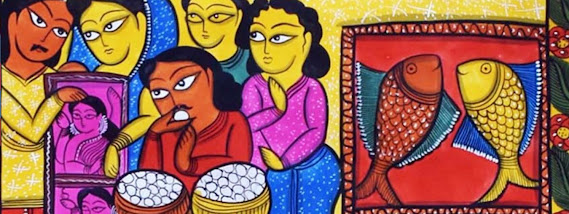
This exhibit, launched on the occasion of World Art Day, narrates the popular folklore of a fish wedding that the Patachitra artists, aka Patuas, of Pingla beautifully depict through their scroll paintings, songs and diverse products. The fish motif is commonly used in Patachitra paintings. This fish motif comes from the folklore of the Fish Wedding (maacher biye). Patachitra artists typically paint on various subjects – mythology, folklore, social issues but Fish Wedding story is one of their favourites. The story is about the wedding of a Dariya fish, where all the fish have been invited. The narration starts with their merry-making and feasting. Amidst all this the fishes don’t realise that danger is looming large. The Boal fish, known as a monster fish, pops up and swallows everyone because he was not invited to the wedding.The story is also interesting for its metaphorical representation of power based societal divides. The exhibit also showcases the popularity of the fish motif through its depiction on different products such as saris and home decor, as well as the GI (Geographical Indication) logo of the art form.

Holi: The Festival of Colours
https://artsandculture.google.com/story/oQXB0ggTs0eutw

This exhibit, launched on the occasion of Holi, tells stories of the different cultural aspects of this traditional festival of colours that is manifested in songs, dance, architecture and craft. The festival of Holi is celebrated across India by every region in their own unique ways. Similarly the Rarh region of Bengal (Birbhum, Bankura, Bardhaman, Medinipur, etc) is known for its different manifestations of Holi festival through folk songs, dances, rituals, and local crafts. The story highlights art forms like- Jhumur, Baul, Patachitra, Wooden dolls of Natungram, and Terracotta. It showcases the different myths and legends especially of Lord Krishna that are associated with the celebration of Holi in the Rarh region and how that has found an outlet in the cultural fabric of the region.

Discover more on Google Arts & Culture: https://artsandculture.google.com/partner/banglanatak
Darjeeling and Kalimpong Folk Festivals: Celebrating Hills’ Heritage

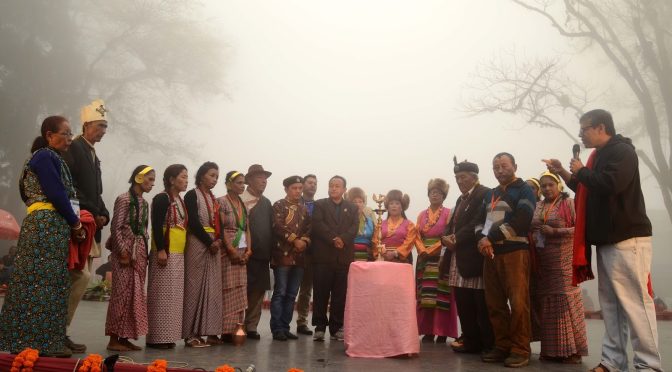
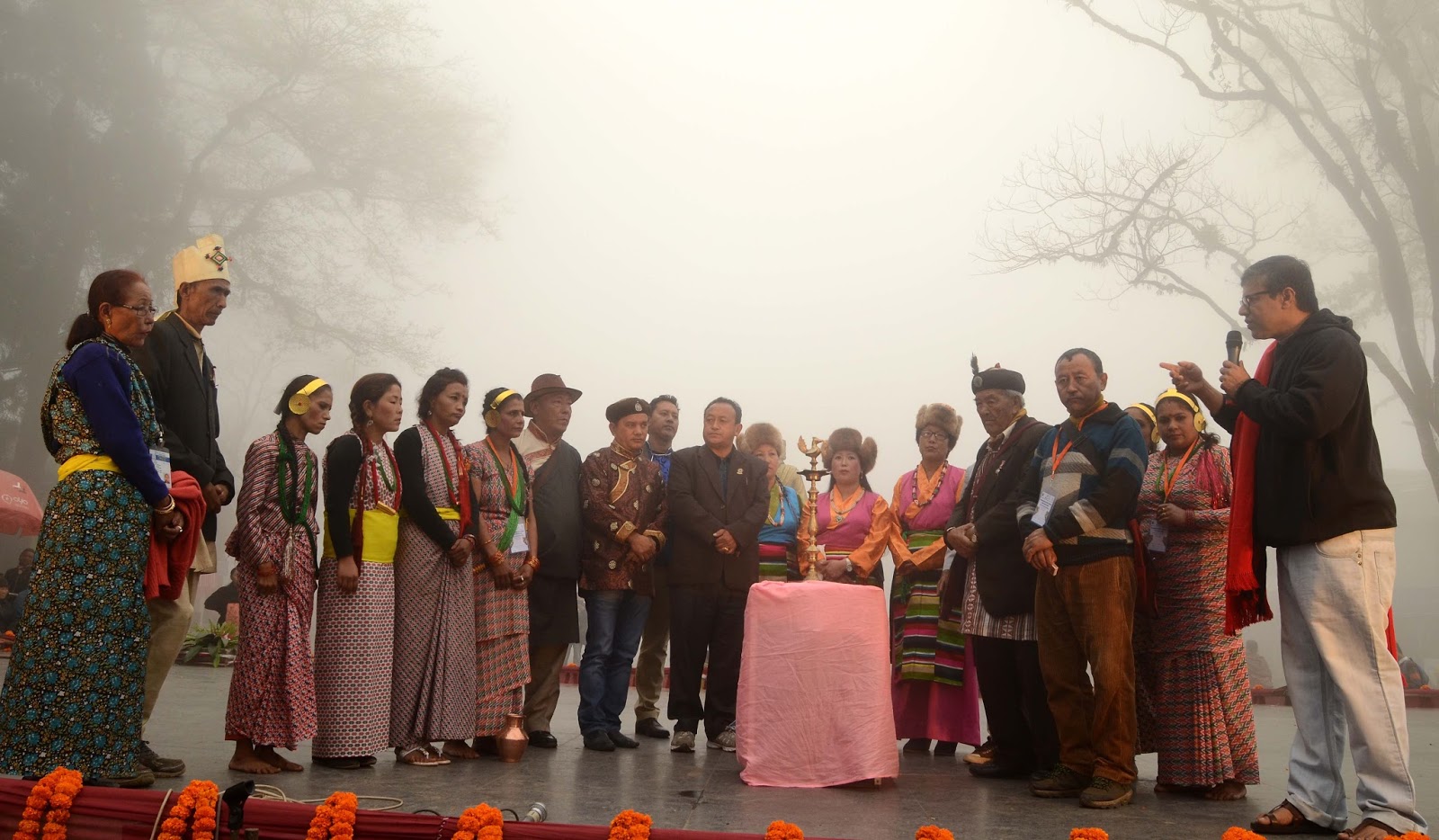
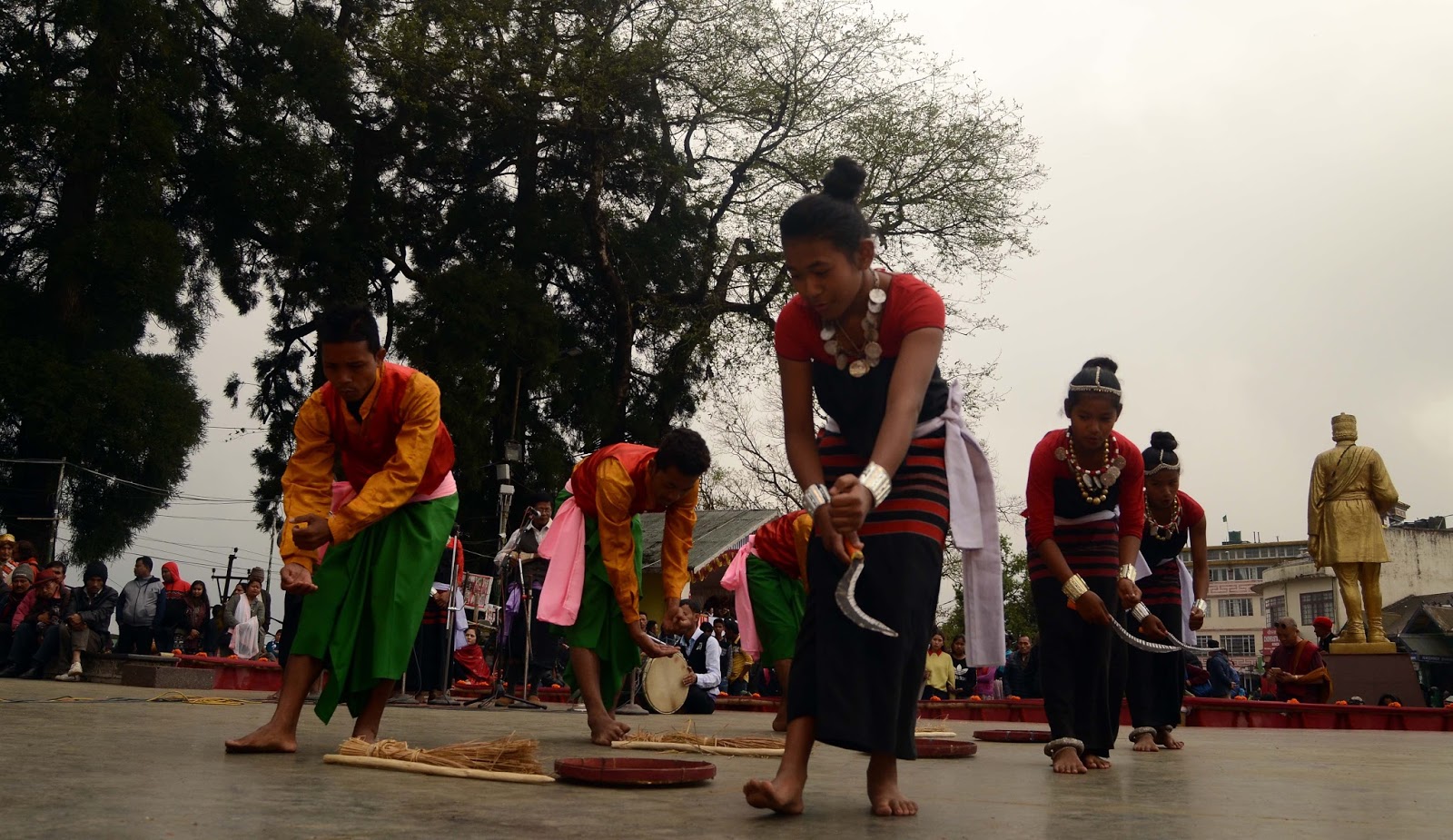
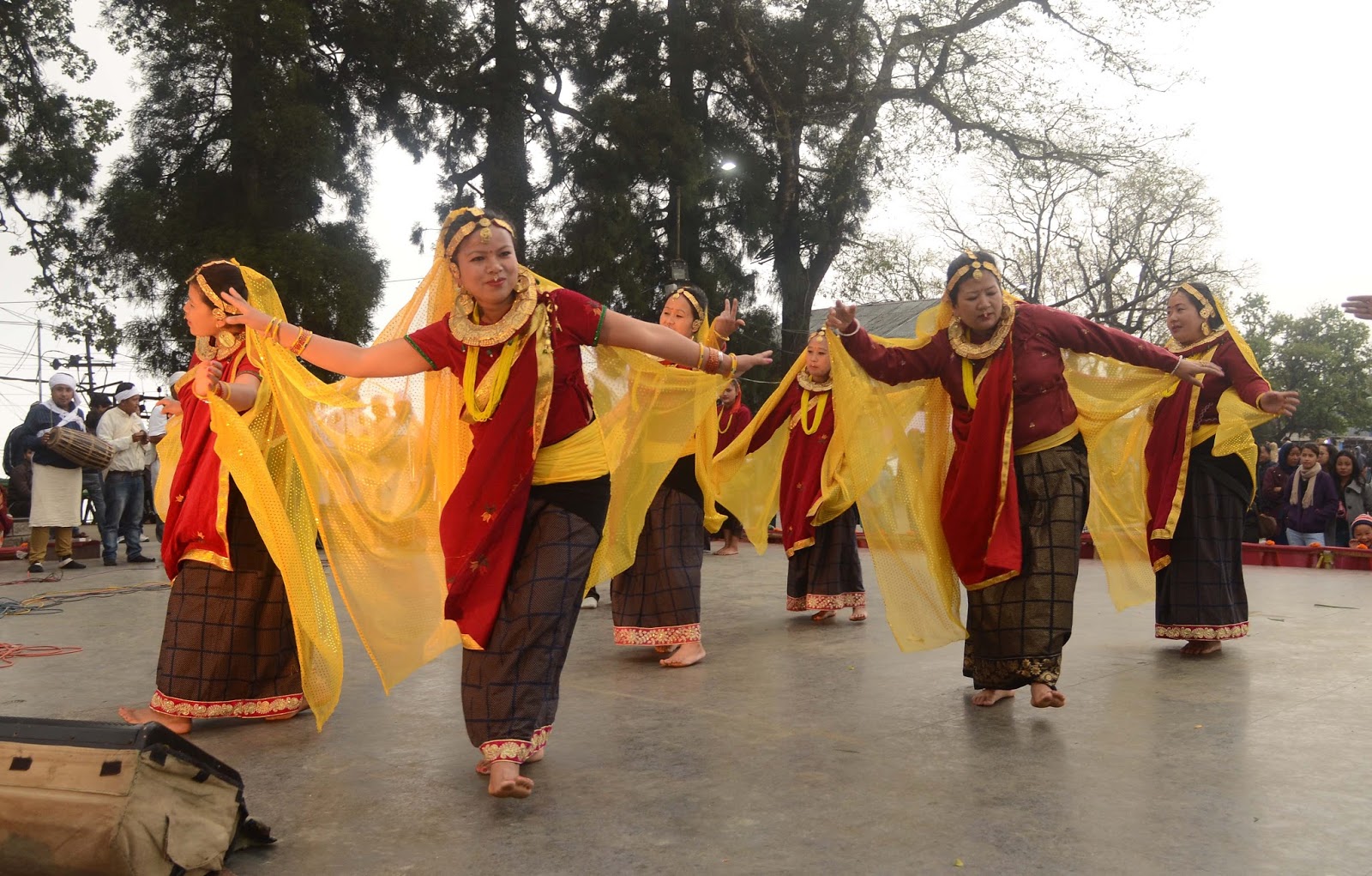
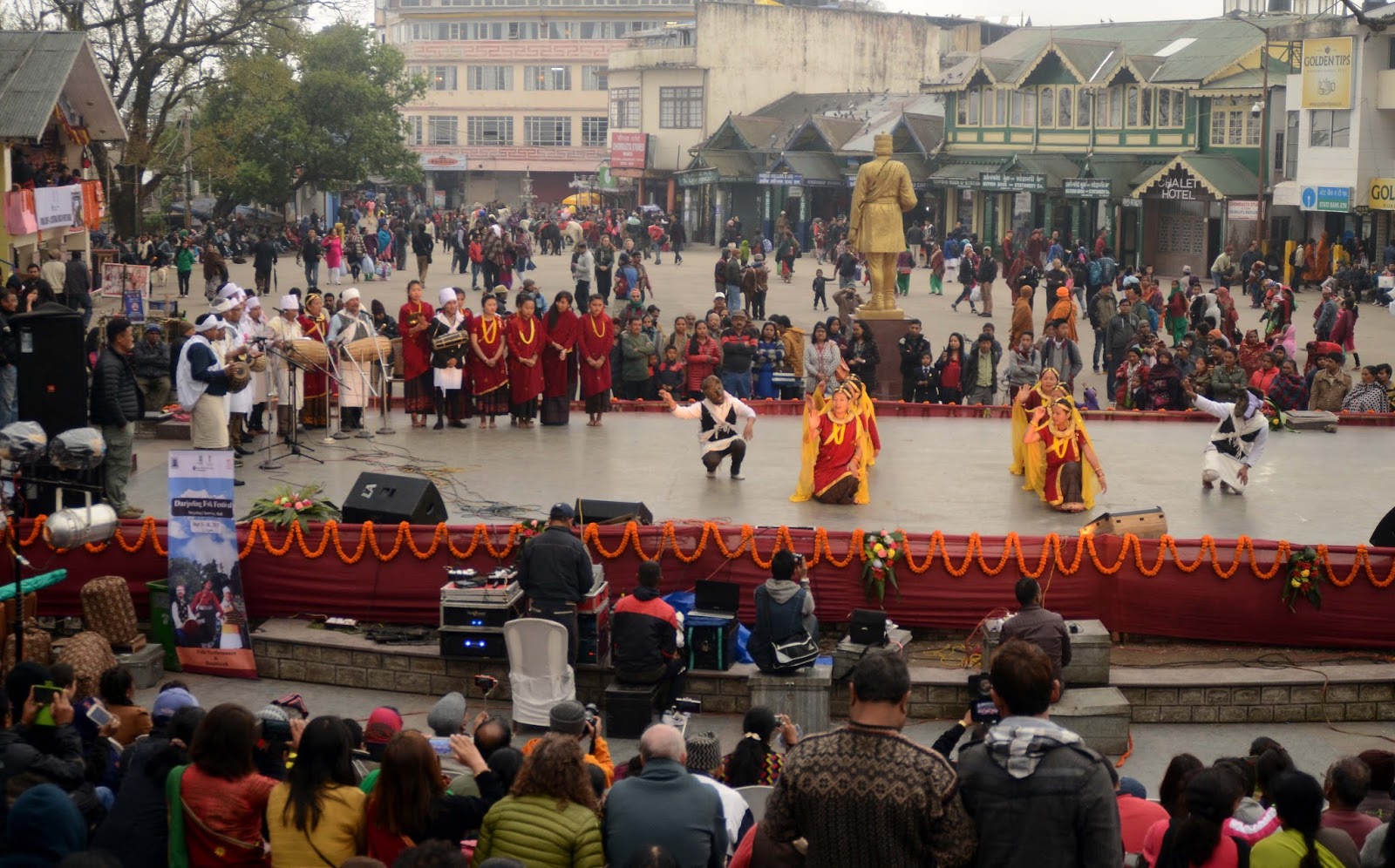
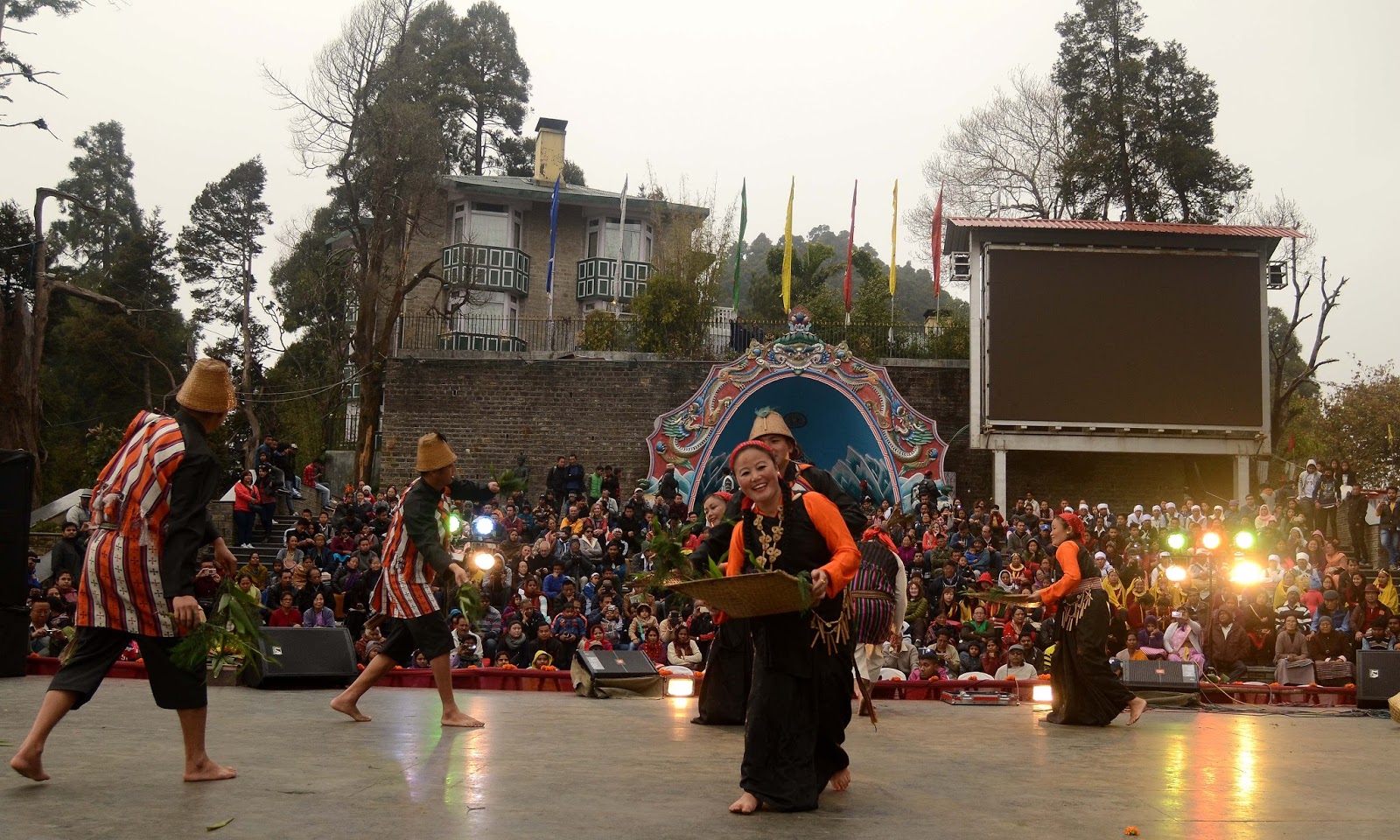
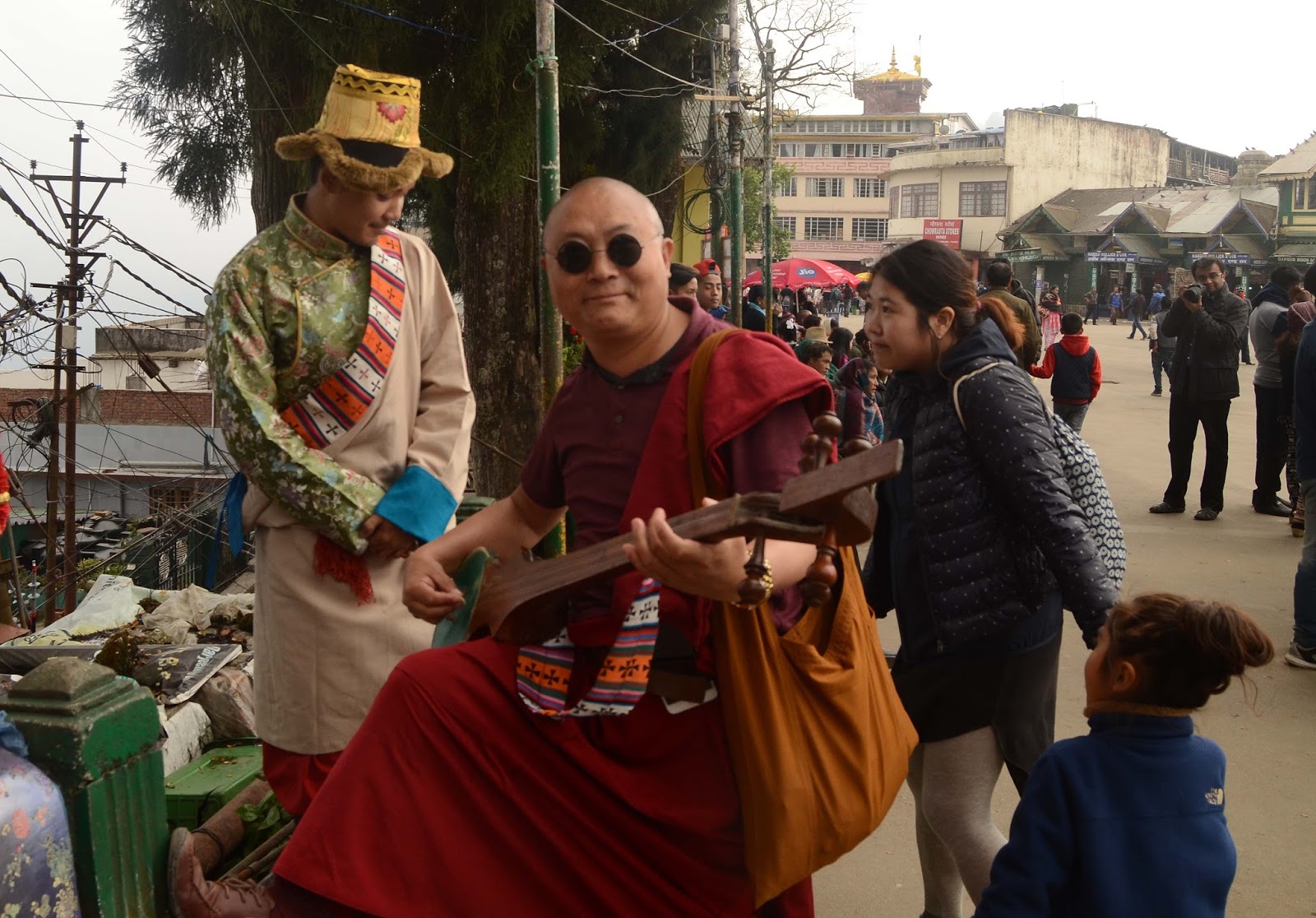
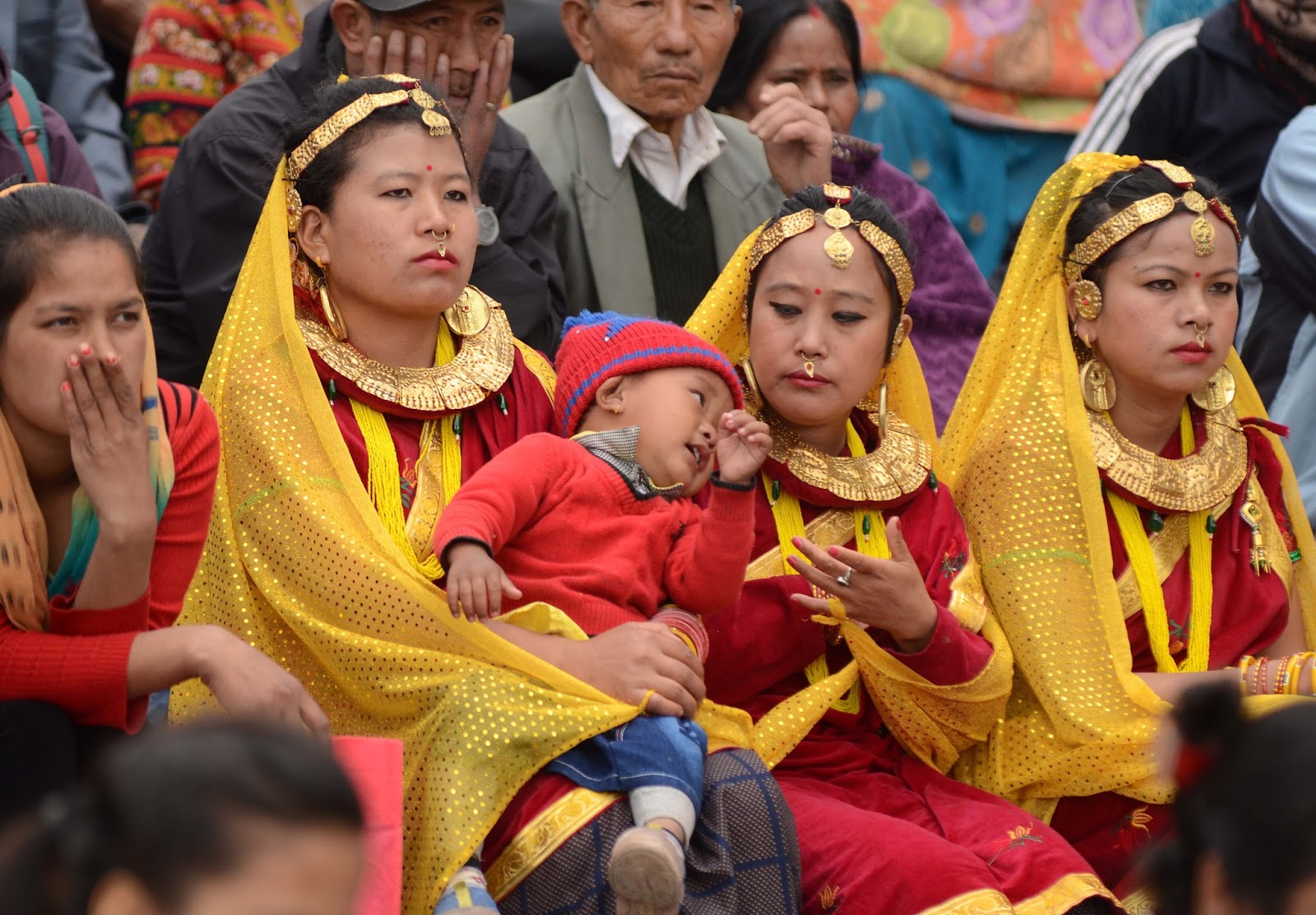
Tucked away in a green, serene, and often surreal, surrounding on the lap of the Eastern Himalayan Range, Darjeeling is not only a requiem for tired urban souls, and the undisputed Queen of the Hills, but much more… To begin with, it is home to 14 indigenous communities who make up an amazing mosaic of pristine traditions, rituals and folk cultures that have, unfortunately, remained virtually undiscovered by the world outside.It was with this long-felt need to showcase the rich intangible cultural heritage (ICH) of the Hills that the Rural Craft and Cultural Hubs (RCCH) project of the Government of West Bengal hosted its first editions of Darjeeling and Kalimpong folk festivals in April and May 2017, respectively. Around 200 local artists participated in the event at Chowrasta Mall in Darjeeling on 5 and 6 April, while over 400 local artists and craft persons took part in the festival at the Mela Ground in Kalimpong on 27 and 28 May. An exhibition on Darjeeling Himalayan Railway, which has been conferred UNESCO’s World Heritage status, was another attraction at the Darjeeling event. Stalls of traditional handicrafts, dresses and cuisine were also a big hit among tourists and locals.

Senior officials of development boards set up for the 15 communities also graced the occasions. Both print and television media extended cooperation with extensive coverage of the festivals.

Padmashri awardee, veteran folk musician-composer-lyricist, Mr Sonam Tshering Lepcha (pic below) inaugurated the Darjeeling Folk Festival. A soldier-turned-musician born in Kalimpong in 1928, he was the first from his Lepcha community to sing for All India Radio. He received the Sangeet Natak Akademi Award in 1995 and the Tagore Akademi Ratna Award in 2011. Mr Sonam Tshering Lepcha is also the founder of a museum that is a virtual mine of rare Hills artifacts, indigenous musical instruments, ancient weapons, and manuscripts.

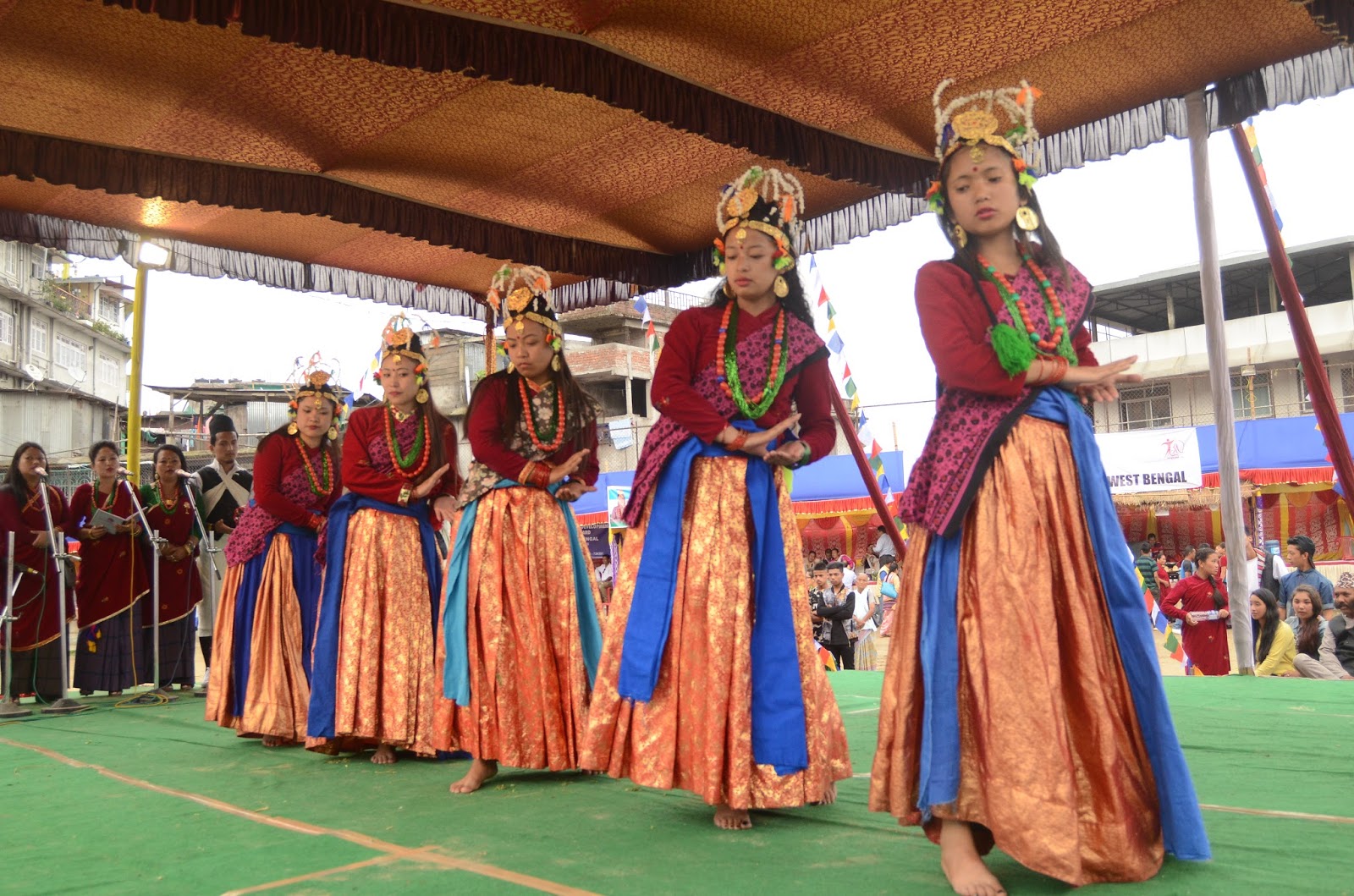
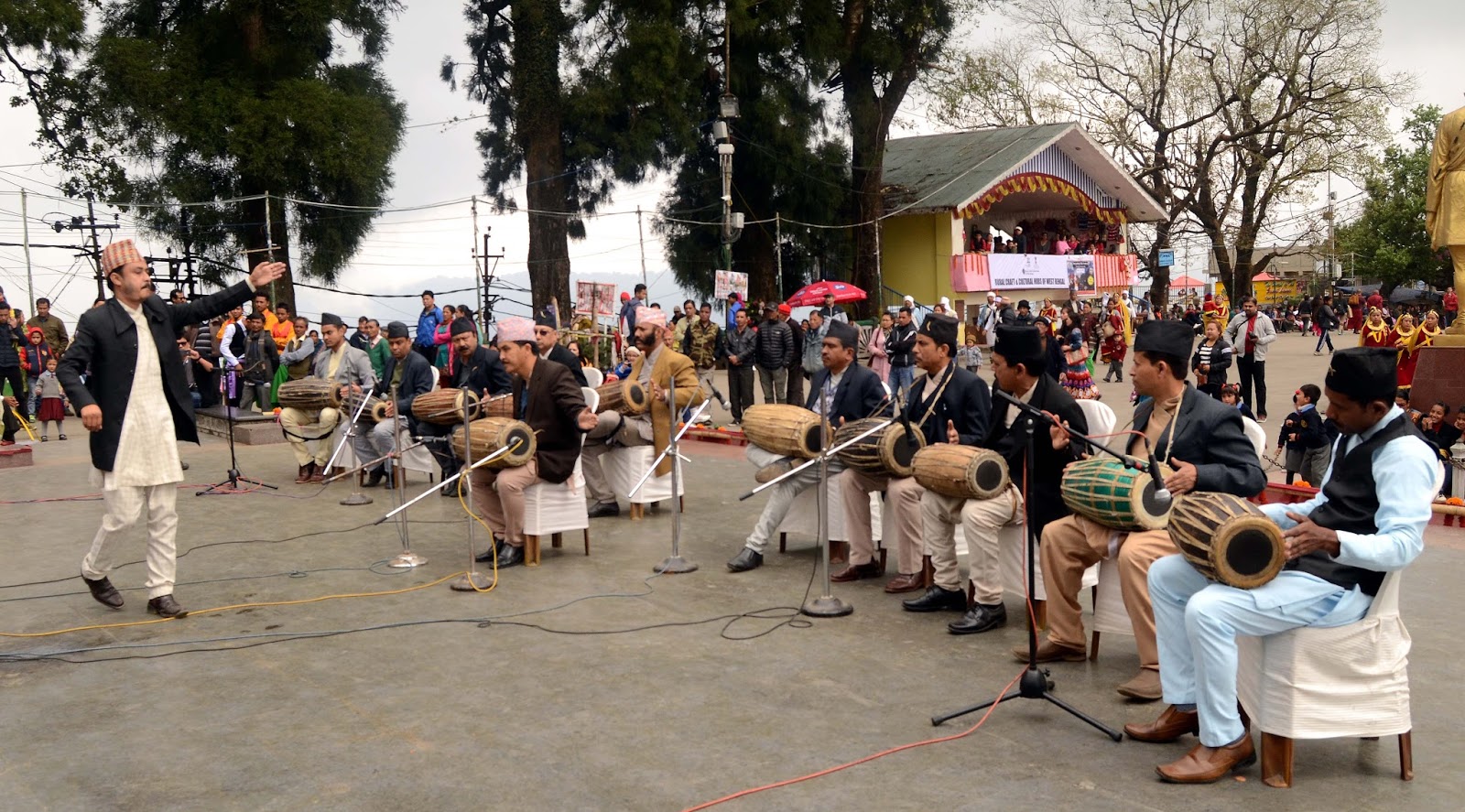
The spectrum of performances was a wide one, right from the captivating Chyabrung dance of the Limbus, to the colorful and amazing Dhimal, Snow Lion and Balun dances, to soul-stirring opera songs of the Tibetan and Tamang communities and the extraordinary Naumati Baja, an ensemble of nine traditional instruments played by members of the Damai community. There was also the aesthetically poignant Lakhe dance of the Newars and the lively traditional dance of the Gurungs.

There were three folk dances with songs presented by the Gurung community. Of them, Ghatu Naach is one that is traditionally performed during Lossar and Buddha Purnima, while Rodhi is one performed by men and women together (pix below) , and Satighatu Naach is a ritualistic dance performed after someone’s death in the community. The music instruments used during the performances included Murchunga, flute and Chong Merdong.

Members of the Tamang community showcased two dances accompanied with songs. These were Sang Shergem, which is actually part of a ritual performed during Lossar and weddings, and Gurki Wai, a romantic song and dance done by men and women together. Their music instruments included Damphu and flute.

Five dances were presented by the Dhimals, each accompanied by a song (pix below). Deradir Puja was one of them. It is performed to worship goddess Lakshmi. Another was Poyanpoka Le Hiyaka. It is essentially a dance performed before people go for fishing. Then there was Um Cheka Le, a traditional harvest song, and Shikarkhaka Le Hiyaka, a song and dance performed while people go to hunt in the jungles. Mandachaka Le Hiyaka, a romantic dance, stole many a heart at both the festivals. The music instruments used included Murchunga, flute and Chong Merdong.

The Mangar community’s troupes presented three dances with songs. Of them, Hurra is one for harvest and weddings (pic below), while Koura Naach is a romantic song and dance performed by men and women together, and Maruni Naach is a wooden mask dance by men and women. The music instruments used for these presentations included Madal, flute, Murchunga and Sarengi.

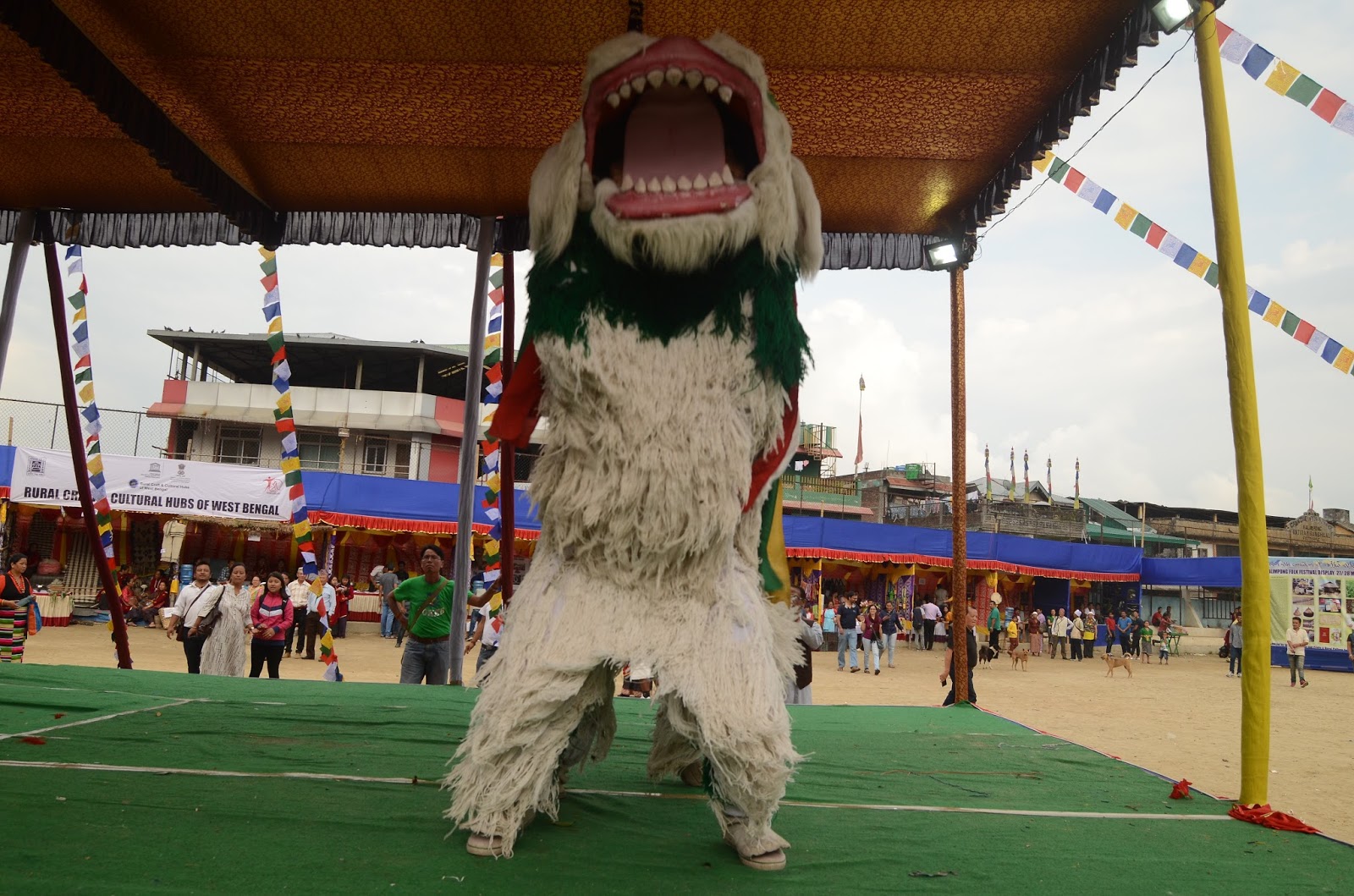
The Tibetan troupes also presented three dances accompanied with songs. The most striking was Ngonpai Dhon, a ritual hunting dance (pic below). There was also Sharchok Potala, performed in praise of Buddhism and the Potala Palace. And, finally, there was Snow Lion Dance (pic below), a combination of dream, fantasy and the mythical creature called Snow Lion that mesmerized the audience, especially children. The musical instruments at work included drums and cymbals.

The Rai community showcased two dances, presented with songs. While Sakela Sili or Sakewa Sili was a sowing and harvest dance by men and women together, Chowan Sili was a traditional dance that stood out for its elegance. The music instruments played with the two included Yele, Binayo, Murchunga, Dhol and Jhyamta.

This Limbus presented four dances with songs. These were Manglang Dance, also called Yuma worship, Ke Lang, a traditional dance accompanied by Chyabrung drums, Ye Lang, a harvest dance performed by men and women together, and Mama Lang, another dance accompanied by Chyabrung drums with a catchy rhythm. The main music instrument was Chyabrung.

Members of Khas community presented two dances with songs, Sangini (pic beow), a romantic one, and Balun (pic below), based on the Ramayana.

Three teams of the Sherpas presented three dances with songs. One was Sherpa Dance, performed to please the groom and his family during weddings. Another was Nadin, performed on auspicious occasions, while the third one was Sileba, which is a dance to welcome guests (pic below).

The audiences also got to catch a glimpse of three dances of the Lepchas, each presented with a song. Naamban and Namaal Geet was one of them. It is performed to celebrate New Year. Chyu Rum Faat Alak was another. It is a traditional dance performed to show people’s respect to the Himalayas. Padam Baino was the other one. It is a traditional dance with an earthy touch.

Bhutias showcased five dance forms. Pow or Lappay Dance, performed to welcome guests, was one of them. There were also Dukpa Kazokpa, a traditional song and dance for weddings and other happy occasions, Lungpa Chung Zung, a traditional dance performed only by men, Gosa Dho Dho, another traditional dance, and Dukpa, a traditional dance marked for its colorful presentation.

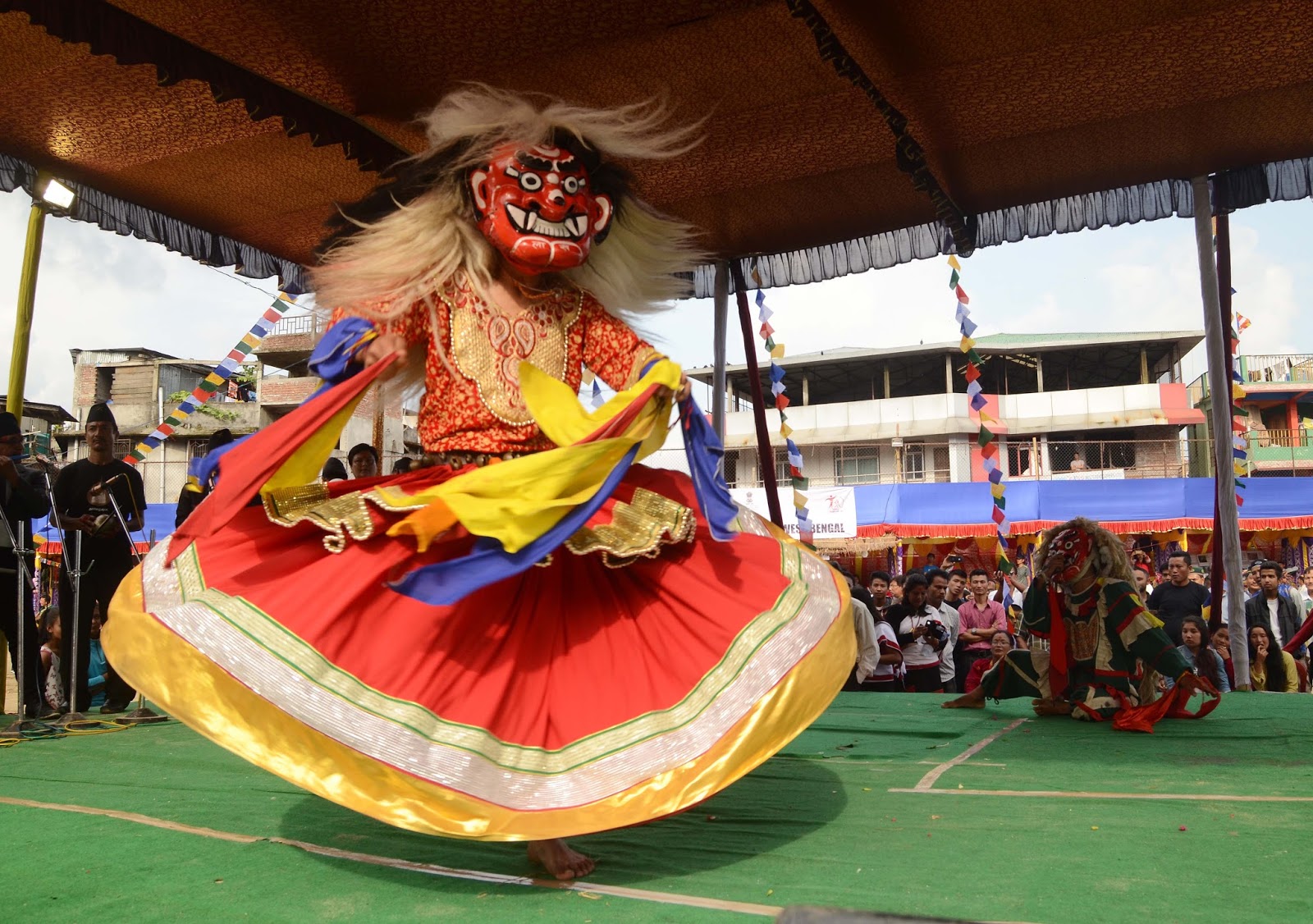
Two troupes of the Newar community presented two dances with songs. One was Lakhe Pnyakho or Lakhe (pic below), a vigorous mask dance performed during Indrayatra, while the other was Kathi Pnyakho, performed at weddings and other such happy occasions.

The Kami community, better known for making the traditional weapon called Khukhri, presented their own folk dance, Maruni.

The Damai community’s unique music genre, Naumati Baja, captivated the audience. It was an ensemble of nine traditional musical instruments. The artists first performed Dabling, which was followed by Mangaldhun and Kheyali.

Swaying to the rhythms of these earthy tunes and tapping their feet in sync with the dance steps, tourists and locals alike lost themselves for a few hours and cherished the presentations. Both the festivals were a grand success. But more than that, both the events will be remembered for their zest for life and a rediscovery of the Hills communities’ ethnic roots and cultural moorings.

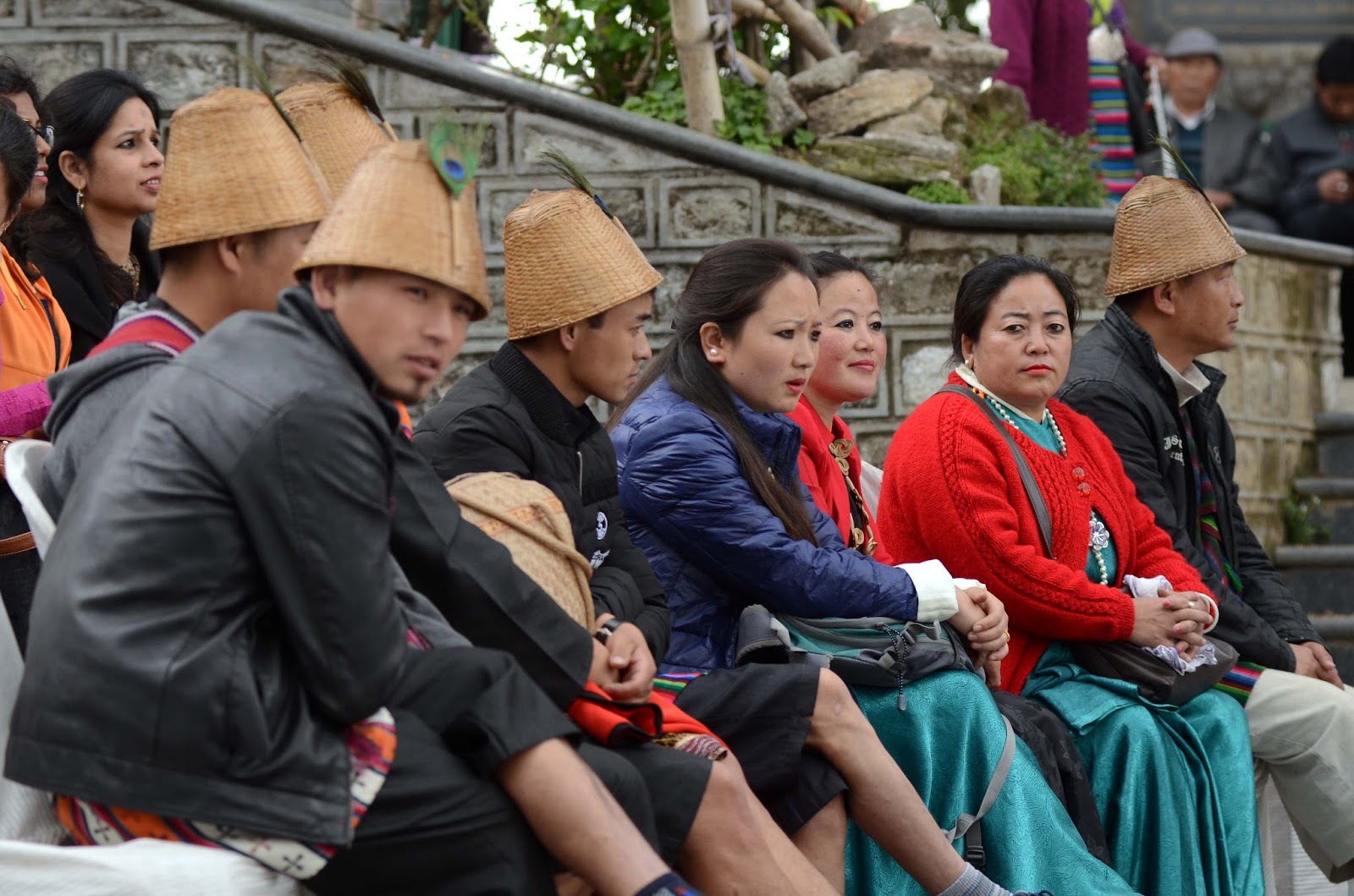
A glimpse of the audiences at the two festivals:


Cultural Industry and the Pandemic: Needs and Challenges

by Anindita Patra

In these unstable and uncertain times, we need to look to the things that unite us – the things that show us the world in all of its variations – and for that, we need artists” – Audrey Azoulay, UNESCO Director-General.

We turn to art when we are joyful: we turn to art when we grieve. And in times of uncertainty and despair, we turn to art again for sustaining our hopes. This is especially true of now when the pandemic continues to disrupt and alter our lives. More now than ever, art must remind us of the human capacity to endure, re-imagine and create.  While billions of people around the world turn to culture as a source of comfort and connection, the impact of COVID-19 has not spared the cultural sector threatening the livelihoods of the local communities and cultural professionals. This has impacted not only revenues but also sense of community and cultural lives of people. Artists across the world are struggling to make ends meet. In India, the crafts sector that is largely self-employed involving a large number of people has been facing a severe crisis. Similarly living traditions such as festive events that form an important part of people’s lives have had to be paused. Today, we are experiencing a cultural emergency.

Keeping these challenges in mind UNESCO New Delhi in collaboration with banglanatak dot com organized two webinars on‘Building Resilient Communities Practicing Intangible Cultural Heritage’ and ‘New Paradigms in Rural Cultural Industries’ on June 10 and June 18, respectively.  The objectives of the webinar was to raise awareness about the impact of COVID-19 on cultural and creative sector based on heritage skills in art and crafts including cultural tourism, to identify needs and challenges to be addressed through development of policies, programs and financial mechanisms aimed at empowering artists  and to share voices of ICH communities and experiences from different countries. The webinars were part of the larger global movement called ResiliArt started by UNESCO on the 15th of April 2020 which aimed at mobilizing solidarity among artists and cultural professionals.

Speakers

The webinar had panelists representing government, creative and cultural sectors, art council, tourism, and technology providers. Eric Falt, Director and UNESCO Representative to Bhutan, India, Maldives and Sri Lanka and Junhi Han, Programme Specialist and Chief of Culture Sector, UNESCO New Delhi shared about ResiliArt initiative.

‘Building Resilient Communities Practicing Intangible Cultural Heritage’

  • Sreya Guha, IAS, erstwhile Principal Secretary Art & Culture and Tourism, Government of Rajasthan
  • Johannes Theurer, Senior producer, Radio Berlin & Secretary, World Music Chart Europe
  • Dr. Sunil Chitrakar, CEO, Mahaguthi Craft with Conscience, Nepal
  • Shahid Hussain Shamim, Senior Vice President, Handicrafts Manufacturers and Exporter Association of Bangladesh – BANGLACRAFT
  • Gopinath Parayil, Founder, The Blue Yonder offering cultural experience intimately connected to local communities

New Paradigms in Rural Cultural Industries

  • Tarun Bansal, CEO, Arya Niwas Hotel Chain, Rajasthan
  • Mr. Pankaj Manchanda, Founder and CEO, Augtraveler offering augmented reality based multimedia solutions offering heritage tourism experience
  • Dr.Debanjan Chakrabarti, Director, Eastern and North Eastern India, British Council India
  • Ms. Neelam Chhiber, Co-founder and Managing Trustee, Industree Foundation organizing creative manufacturing ecosystem for micro entrepreneurs
  • Mr. Sanjoy Roy, Co-founder and Managing Director, Teamwork Arts developing festivals across the globe.

The panelists discussed various problems that the artist communities are facing due to the pandemic. The social and economic impact on culture and creative industries will be severe and these sectors, like many others, will need support across their respective ecosystems and supply chains. The crafts sector in India, one of the largest employment sectors after agriculture in rural India, is in a severe crisis affecting livelihoods of millions of craftspeople in rural areas and thousands of craft enterprises. Similarly, the arts sector is also under huge pressure being informally organized with artists and professionals working on temporary contracts, lack of funding and lack of adequate protection of artists’ works especially in the digital sphere. Creative industries like craft collectives, village tourism, cultural festivals which support the tradition bearers and practitioners are threatened with challenges of decline in demand owing to factors like decline in tourist flows, less disposable income of consumers and restrictions in cultural and social gatherings.

But as they say, there is light at the end of the tunnel. The panelists agreed that we need to find ways to keep cultural professionals doing their work safely and to be able to monetize their work we need to build solid cultural policies to give artists, creators and cultural enterprises the means to move forward. One of the big challenges facing the creative sector in the developing countries as we emerge from this pandemic will be the restructuring of the cultural sector. Regenerative economy is the need of the hour and instead of calling this sector craft we call it creative manufacturing as it is about production, competitiveness. Craft should not be limited to a curio item but treated as a production model or rather participatory ownership model.

The discussion emphasized the importance of solidarity for artists and creators. If we try looking at the ‘oh so little’ bright things of the otherwise dark crisis we will see that it has the potential to bring together the cultural industry, to start a dialogue, to collaborate and exchange, to create a rock solid networking platform. Hand holding amongst the stakeholders of the creative industry will be really helpful in such times.

A particular concern raised by the panelists was the rapid trend toward the digitization of cultural content which is indeed a good means for the artists to reach out to the audience. But a lot of the rural artists are not equipped to quickly jump into the online world, because of the remoteness, insufficient access to digital technologies and language issues. The importance of vigilance and stronger regulation amidst the current push for digitization cultural content was particularly stressed. The fact that so much is moving online and artists are sharing their work for free brings challenges as well.

When emerging from this crisis, ways to maintain diverse, sustainable and dynamic cultural ecosystems must be identified and reinforced. Panelists underscored that the ramifications of the crisis will be felt long after it ends, and called for the protection of artists and for fair remuneration of their work both now and in the long term.

The discourse that we read and see in the media understandably focuses on the negative impact but there are positive opportunities as well– opportunities for contributing and collaborating and ones which may lead to new innovations. Sustainable business models during and after the initial crisis are vital for the sector’s survival. The current challenge is to design public supports that assuage the negative impacts in the short term and help identify new opportunities in the medium term for different public, private and non-profit actors engaged in cultural and creative production and not to forget initiatives that ultimately benefit the communities. The discussion reflected the need to re-imagine the cultural sector as it adapts to the new normal brought about by the crisis.

We realize that during these times projects will need fresh modes of thinking, creating and presenting the arts as well as new imaginations of engagement with audiences and communities.

Culture as an Influencer

 Role of Social Media Influencers in Promoting Cultural Products

by Anindita Patra

Today social media platforms have become an important tool to promote products and services. Social media marketing is inexpensive when compared to the traditional ways of advertisement, reaches out to a wider audience and is fast in its response. By using social media, brands have the chance to create a strong media presence by interacting with customers online, this can also help to strengthen brand perception by communicating core values to a wider audience.

With social media platforms taking the centre stage in the world of marketing we often hear the term ‘social media influencers’. So, who are these influencers? An influencer is someone with the power to affect the purchasing decisions of others because of his or her ‘authority, knowledge, position, or relationship with his or her audience’. An influencer has a digital following in a distinct niche, with whom he or she actively engages.  Over the last decade, we have seen social media grow rapidly in importance. According to the January 2019 We Are Social report, 3.484 billion people actively use social media – that’s 45% of the world’s population. Inevitably these people look up to influencers in social media to guide them with their decision making.

Over the years we have seen these influencers create campaigns for fashion, beauty, travel, lifestyle. With the world becoming more aware about sustainability we find a lot influencers promoting sustainable living, home grown products, small local businesses. Keeping these in mind as a part of the HIPAMS project we decided to take the plunge of involving social media influencers with a little push from our colleague and marketing expert Dr. Diego Rinallo from Kedge Business School, France in order to promote Bengal Patachitra.

Promotion of cultural products by social media influencers is not a common sight especially in India.   Mapping a strategy to involve influencers rather the ‘correct’ influencers with a campaign that would not only try to sell the craft products but at the same time create awareness about the art form, the artists, their rights, the heritage aspects of the art form was a challenge.

We had to be extra careful while choosing the influencers we wanted to work with, keeping in mind our target audience. After much research we reached out to influencers who promoted sustainable fashion, home décor with traditional art pieces, small businesses, cultural products, rural tourism on their respective pages. Influencers with different followership were approached though focus was more on the micro influencers with followers less than 10k. Micro influencers with their less followership have higher engagement, niche audience and is cost effective.

Other factors like deciding on the storyline of the promotion, the timeline of the posts, type of content, scope of enganement with the audience had to be kept in mind as well. Diwali is an important festival in India where people buy new clothes and gifts, clean and redo their houses. So, we launched our social media campaign during Diwali in the year 2020 with the message to rethink fashion and gifting choices and support local artists going with the trending #vocalforlocal, #supportart, #supportartist campaigns that were already doing the rounds in the country. The influencers posted on how to drape a Patachitra saree for Diwali parties or how to decorate the house with Patachitra pieces like kettles and coasters. 84 Bongully, an Instagram creator beautifully adorned garments with Patachitra motifs to create festive looks for their follwers whereas influencer Sharmistha Guha Chowdhury made a video on how one can use Patachitra products to add a festive touch to their house décor. An young fashion influencer sported Tshirt with Patachitra motifs and gave out the message to her millennial followers on how to make traditional art look ‘cool’.We kept in mind to not only promote the products but also the artist, the process and the place where it came from. So along with every post the influencers mentioned about the art form, the artist who painted it and about his/her village. The campaign was a success as the Patachitra artists received orders from people who came across the Instagram posts of Patachitra by the influencers.

The second phase of the campaign was held during World Heritage Week in November, 2020 and focussed on creating awareness about the heritage aspects of the traditional art form. For this phase of the promotion influencers like art photographers, policy advocates, environmentalists were utilized. For example, the ace photographer Upahar Biswas made a video explaining why it is important to mention the name of the art form and artist while sharing photos of Patachitra products. The heritage aspects of Patachitra like Pater Gaan (songs accompanying the scroll paintings), natural colour making process were shared along with information on GI (Geographical Indication) registration, Craftmark, the village as a cultural hub, community museum. The audience engagement during this phase of the promotion was very encouraging.

During the month-long promotion three short videos, 22 posts and around 30 stories were shared by the influencers on their respective pages. The videos have received around 3000 views; each post on average had received 350 likes. The influencers who worked with us on the promotion of Bengal Patachitra were happy about the campaign and the response they received. They said that cultural products have a huge market out there and it just requires the correct branding to reach the customers.

Do visit our Instagram page to get glimpses of the beautiful campaigns: https://www.instagram.com/hipams.india/


Name of Influencer Social media handle No of followers Area of Expertise
Sreenanda Ganguli sreenanda.ganguli 4k Lifestyle
Roshni Sen & Paushali Majumdar 84bongully 26.8k Art, textile, craft
Upahar Biswas upaharbiswas 9k Art photographer
Rishika Das Roy themillenialsguidetothegalaxy 7k Climate Change and Policy
Sharmistha Roy Choudhury nomadicwardrobe 18.9k Sustainable fashion and home decor
Mandira Paul M A N D I R A 5k Fashion
Debarati Ghosh debaratighosh 5k Fashion

Sustainable development and Intellectual Property Rights: The case of Patachitra and GI

 ‘Green GI’ and Sustainable Development

Intellectual property rights (‘IPRs’), particularly geographical indications (‘GIs’), can be an excellent tool for encouraging environmentally friendly practices. The emergence of “Green GIs”, which are both environmentally friendly and compatible with the maintenance of biodiversity and landscape, reflects the utility of using IPRs on traditionally produced goods. These GIs are considered capable of providing prospects for new forms of rural development, community autonomy, preservation of cultural traditions, and even conservation of biological diversity. This is particularly the case when the production of goods encourages the stewardship rather than the depletion of the natural resources from which they are made.


GIs have the capacity to recognise and, in line with the nature of the GI itself, protect positive environmental practices. As a point of illGIs have the capacity to recognise and, in line with the nature of the GI itself, protect positive environmental practices. As a point of illustration, the ‘Green’ EU GI specification of jersey royal potatoes indicates that the majority of crop is planted by hand. While artificial fertilisers are used, locally collected seaweed, an excellent source of organic fertilizer and flavour enhancer, is used extensively. Similar examples include the EU GI specification of Arroz de Valencia and Diepholz Moor Lamb. Indeed, other IPRs, including the regulation of collective trademarks for instance, are equally capable of recognizing and protecting environmentally sustainable practices.ustration, the ‘Green’ EU GI specification of jersey royal potatoes indicates that the majority of crop is planted by hand. While artificial fertilisers are used, locally collected seaweed, an excellent source of organic fertilizer and flavour enhancer, is used extensively. Similar examples include the EU GI specification of Arroz de Valencia and Diepholz Moor Lamb. Indeed, other IPRs, including the regulation of collective trademarks for instance, are equally capable of recognizing and protecting environmentally sustainable practices.

Recognition, Knowledge, Resilience

The Operational Directives for the Implementation of the Convention for the Safeguarding of the Intangible Cultural Heritage were first adopted in June 2008. In particular, the Directives contained in Chapter 6 establish a framework related to ‘environmental sustainability’ which is relevant for the adoption of IPRs on intangible cultural heritage (‘ICH’). The framework consists of three pillars (UNESCO 2018):

Recognition: The first theme is the recognition by States Parties of ‘environmental impacts in the safeguarding of intangible cultural heritage’.

Knowledge: The second theme, ‘knowledge and practices concerning nature and the universe’, encourages the recognition of ‘communities, groups and individuals as the bearers of knowledge about nature and the universe and as essential actors in sustaining the environment.’

Resilience: The third and final ‘pillar’ of this framework relates to ‘community-based resilience to natural disasters and climate change’, according to which States Parties should ‘fully integrate communities, groups and individuals who are bearers of such knowledge into systems and programmes of disaster risk reduction, disaster recovery and climate change adaptation and mitigation.’


The first pillar of the IPR on ICH framework is twofold. States should: a) encourage environmentally friendly practices, and b) mitigate any possible harmful impacts (UNESCO 2018). An example of an intellectual property (‘IP’) strategy that encourages good practice and recognizes environmental impact relates to Coorg Orange.In the case of this crop, local producers have successfully used IP, creating positive impacts on the landscape and its associated biodiversity.

The second pillar recognises the community as bearers of knowledge about nature and essential actors in sustaining the environment. To illustrate, the Indian GI specification of Coorg Arabica Coffee indicates that the modern method of Coorg coffee cultivation serves as the backbone of the kodagu district and is integral to the lives of the people in the district (Coffee Board Bengaluru 2017). Furthermore, the specification highlights that coffee farmers growing Arabica and Robusta under shade trees serve the ecosystem and protect biodiversity (Coffee Board Bengaluru 2017). This demonstrates how IPRsare capable of helping to protect the role of communities’ knowledge and adaptation strategies.

This notion of ‘knowledge’ also forms the basis of the final pillar, communities’ resilience in the face of natural catastrophes and climate change.For example, the Turkana of northwestern Kenya have a highly sophisticated natural resource management system that has enabled them to survive in an environment that many would consider extremely hostile.
Patachitra of Medinipur
An Overview

Patachitra is an ancient form of painting done on paper and manifested by rich colourful application, creative motifs and portrayal of simple themes. The word ‘patachitra’ is derived from the Sanskrit term patta (cloth) and chitra (painting). It is practised in several regions of India, with specific Patachitra styles originating in West Bengal and Odisha. Traditionally, the paintings have depicted mythological stories. Today, Naya village is home to 350 inhabitants, of whom at least 50 are highly skilled Patachitra artists, patuas, including an increasing number of female scroll artists. Naya is currently the main village in the Paschim district making and selling Patachitra.

GI and Patachitra
The Indian GI for Patachitra of Medinipur highlights how a community with an IPR that protects cultural practices which have a positive impact on the environment. The precise nature of this ‘cloth painting’ is set out in greater detail in the GI specification. Colour is a key quality of Medinipur Patachitra that is recognized in the specification, which states the five basic pigments, white (Sankha), yellow (Hingula), black (Kala), Brown (Khayeri), indigo (Neela), and their combinations are used for colouring. In the GI application, ‘Bengal Patachitra’, which also covers Medinipur patachitra, is described as a handicraft in classes 16 (painting) and 24 (textiles) (Chitrataru 2016). The suggestion here is that all goods covered by the GI should be hand painted (rather than printed) on a textile. The specification goes on to note, ‘the materials used in the paint are from vegetable, earth and mineral sources.’ Traditional, environmentally-friendly paint is therefore an integral part of this practice. By stating that Medinipur Patachitra must be made using materials sourced in this way the GI recognizes the Patachitra community’s knowledge regarding environmentally sourced paints.
Conclusion
Intellectual property rights are capable of supporting environmental sustainable development for ICH. They are compatible with the three themes of environmental sustainability set out in the ODs and can be used together with other forms of safeguarding, such as marketing labels, to help achieve environmental protection. In the case of Patachitra, we see how GI has the capacity to preserve and promote environmentally-friendly practices while also empowering Patachitra communities to hone their knowledge of natural materials and cultural practices for a positive environmental impact.

Traditional art goes digital in times of crisis

by Anindita Patra

“We tell ourselves stories in order to live” –Joan Didion

Stories of hope, stories of a brighter tomorrow is what keeps us going especially during these times when the entire world is copped up in their respective homes. Art is a great storyteller, art speaks of yesterday, art speaks of today and art speaks of tomorrow. Art connects people in different ways, that maybe be said metaphorically but digital media connects people literally. And what happens when art and digital media comes together during these times of crisis? Magic happens.

I will be narrating such a story today, a story of amalgamation of art and digital media.

Swarna Chitrakar, a Patachitra artist from Naya, West Bengal has become an internet sensation overnight because of her painting on COVID-19. Sounds a bit vague? Well, let me explain.

Patachitra is a traditional art form of West Bengal in which stories are painted on vertical scroll and the Patachitra artists also known as Patuas, gradually unfurl them while presenting the story through songs known as Pater Gaan.  It is a blend of oral and visual storytelling. The Patuas are known for painting and composing songs on social issues.

Swarna Chitrakar, an experienced artist who is already known for her expertise in painting on traditional themes as well as social issues, has developed a 7-frame Patachitra and a song on COVID-19.  The detailed narrative has vividly captured the havoc caused by the virus outbreak. Swarna has represented the virus as a bright red monster in her painting. The Patachitra has highlighted the virus’s origin, health professionals in PPE suits and people in masks. In her vibrant and informative art work Swarna also talks about the precautionary measures one can take to fight the virus. The entire painting has been done with natural colours derived from flowers and plants, one of the special features of Patachitra.

Swarna has performed in different places around the world like USA, France, UK, Germany, Italy, and Sweden. When asked about the inspiration behind her work, Swarna said that world issues have always found a place in her work. She has earlier painted and composed songs on 9/11, and the Tsunami. Continuous discussion about the pandemic, news about it on television, newspaper made Swarna take up her paintbrush to capture it and use her art as a medium to raise awareness.

But it struck her that during the lockdown phase she won’t be able to go out to exhibitions or fairs to showcase her work neither can the visitors come to her village. So, she decided to use the digital platform to present her work.
With the help of her daughter she made a video of the Patachitra narration and sent it to her contacts via WhatsApp. Her contacts shared it on platforms like Facebook and Instagram. And that is how the Patachitra on COVID-19 reached over a million people.  Prasanta Maharana, a Pattachitra  artist from Odisha has also made a Pattachitra depicting the daily lives of the people in a village during the pandemic and shared it on his Instagram account that has received overwhelming response as well-over 10000 views in a week. Amidst the gloom of the pandemic, art and social media have become central to people’s lives. In the recent past we have seen opera performances via video conferencing (https://bit.ly/2TFPd0B), magazine editions going online with covers based on pandemic (https://bit.ly/2M0UDzc).

The rural artists of India are also becoming more digital savvy. Banglanatak dot com (a social and cultural enterprise) hosts an online initiative, the MusiCal Facebook page (www.facebook.com/bncmusical/). Here, traditional artists from rural India have been performing consistently since 29th March and 54 live performances have taken place so far. Out of which more than 10 performances were done by the Bauls and Fakirs from different parts of Bengal. The Live performances have received more than 200,000views in total. Performances by Rina Das Baul (https://bit.ly/3bZi32t) and Babu Fakir (https://bit.ly/2ATx34T) are worth mentioning. They had a live viewership of more than 1500 people.

The senior artists who aren’t very familiar with digital platforms been assisted by younger family members (who were very excited to be a part of the Live performances) to take their art digital in these difficult times. The senior artists were amazed to know that while they’ll be singing in their homes, thousands of people from different parts of the country as well as the world will be listening to them. And it is interesting to notice the choice of song that the musicians performed; the songs were about hope, love and uniting with one’s loved ones, brotherhood. Through their songs they called the Almighty to be the savior of humankind in these trying times. The artists said that knowing that they can spread peace and solace through their music makes them feel very happy as this has always been the purpose of music “to spread love and joy”. The Live performance have also brought the music fraternity closer, seeing fellow musicians perform on screen made them feel connected to one another though they hadn’t seen one another in months. It gave them hope and collective power to fight the adversities.
It is during this pandemic that we have understood the importance and need of digital media to spread art, to promote art like never before. Digital literacy is essential for artists now that the world will be more inclined towards virtual performances. Maybe ‘The Art Newspaper’ was right when they wrote: “When God closes a gallery door, [somewhere] He opens a browser window.”

Tarak Khyapa

Tarak Khyapa was a renowned Baul artist and a Guru. Born in Joydev Kenduli of Birbhum, Tarak Khyapa’s vibrant voice and exuberant dance made people envious. His competency towards Dotara, Khol, Tabla and Gabgubi made him one of the most talented Baul artists.

His primary introduction to Baul was obtained from his father Kanailal. From a very young age he bagan his official training under Sudhirbaba of famous Tamaltala Ashram in Joydev. He also got the guidance of Pagol Ramdash, a well known Baul exponent and lyricist.  Tarak Khyapa had an unlimited stock of songs. His presentation attracted his audience. Understanding each and every bit of the songs he united his soul and body and penetrated the depths of Baul music. He presented the pieces of Lalon Fakir, Haure Gnosai and Nilkantha.

To spread the originality of Baul music and Baul Philosophy he established ‘Baul-Kutir-Sebasram’ where he passed on his skills of singing and Khamak playing to his students and disciples. As a Guru he was very sensitive and friendly towards his students.
At a very minimal time Tarak Khyapa succeeded in establishing himself as a Baul artist of great potential. He traveled beyond his so called barriers to Denmark and South Korea.On 10th October 2017, at the age of 57 he passed away leaving his Baul tradition and his two sons Sadhu and Kangal who are traveler of the same path; they have performed in many places in the country and abroad.

In 2017, Tarak Khyapa recorded an album named Tarak Khyapa (album link) consisting of 10 songs along with his two sons Sadhu and Kangal.