“মাঝখানেতে আছে কেবল পাতা
বিধবা তার মেয়ের হাতের শেলাই-করা কাঁথা।”
— রবীন্দ্রনাথ ঠাকুর, খাটুলি
In the homes of Bengal, kantha has long been part of ordinary life. Traditionally made from old saris and dhotis, these embroidered quilts and household textiles were assembled from worn cloth, then stitched with thread pulled from discarded sari borders.
Making a kantha was, in this sense, an act of reuse. An old piece of cloth could become something new and useful, and still carry traces of the household it came from. The work varied in both skill and scale. Some kanthas were simply stitched; others were densely embroidered. In the finer examples, the stitching that holds the layers together becomes part of the design itself. White-on-white lines form quiet patterns across the surface, while coloured embroidery brings in flowers, animals, people, buildings, and scenes from everyday life. Lotus forms and other motifs recall alpana designs, though no two kanthas repeat the same arrangement. Each kantha reflects the person who made it and in the designs, one can see a cavalcade of life passing in front of one’s eyes.
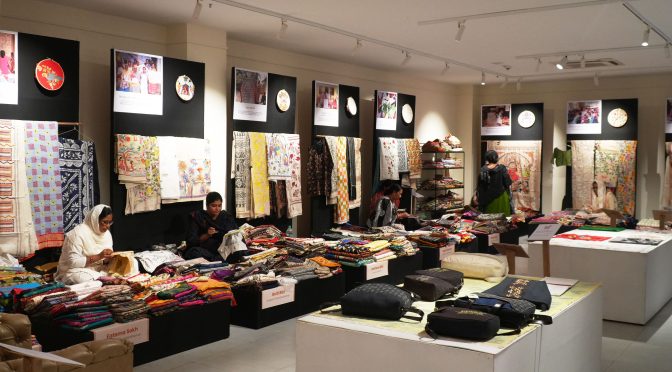
Organised by banglanatak.com’s Contact Base, with CSR support from Coal India Limited, Kantha Kathan: Celebrating the Living Tradition of Rural Bengal took place at the Lalit Kala Akademi Regional Centre in Kolkata from 11 to 16 September 2026. Alongside an exhibition and sale of work by sixteen women Kantha entrepreneurs from the villages of Ausgram and Nanoor, the initiative held a series of afternoon conversations built around three themes: fashion, space, and inspiration.
The panels drew together a wide cross-section of people who think about craft for a living, where scholars, architects, scenographers, and fashion practitioners discussed the trajectory of this intimate folk tradition along with the rural women who stitch the pieces. The conversation centred on a shared preoccupation — how can a domestic, generational practice remain rooted in its tradition while finding a place in new audiences, spaces, and markets?
The Cloth of Everyday Life
“সেই ঘরে বসে কাঁথার ফুল তুলবে স্বপ্ন চুপি চুপি লুকিয়ে, ভবিষ্যতের জন্যে।”
— আশাপূর্ণা দেবী
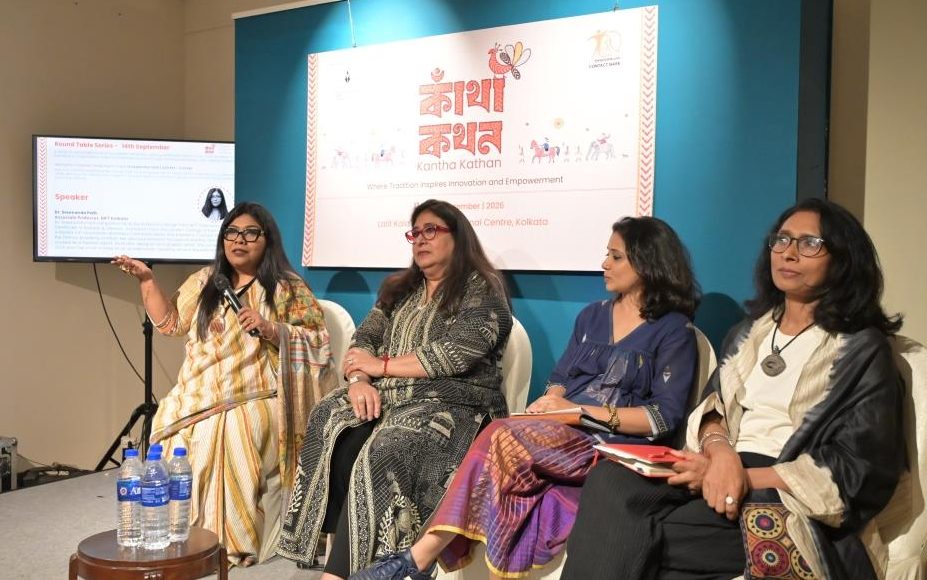
On 14 September, the afternoon belonged to fashion, and the panel Kantha Re-imagined: Designing for Today asked how traditional techniques and visual vocabularies can enter contemporary retail without losing their character. Its moderator, Dr. Sreenanda Palit, is Associate Professor at NIFT Kolkata, and has spent years researching the craft, including a doctorate built partly around it. She began by reminding the room that kantha was never made for decoration alone. “They were all living storytelling pieces… parts of a woman’s life, what she saw around, what she felt, and often as a piece of blessing that got passed on to the next generation.” She recalled the baby quilts in which generations of Bengali children were wrapped, and described the gathering as a conversation about the maker and amidst the maker, one that does not alienate them. She also spoke of a pandemic-era workshop, where she and her team at NIFT interviewed 1,325 artisans to understand the challenges they were facing. The work went beyond documenting those difficulties: workshops were held where artisans were taught how to trace lines, draw designs from scratch, and explore different stitches and forms of expression, while looking for ways to bring their skills into contemporary fashion.
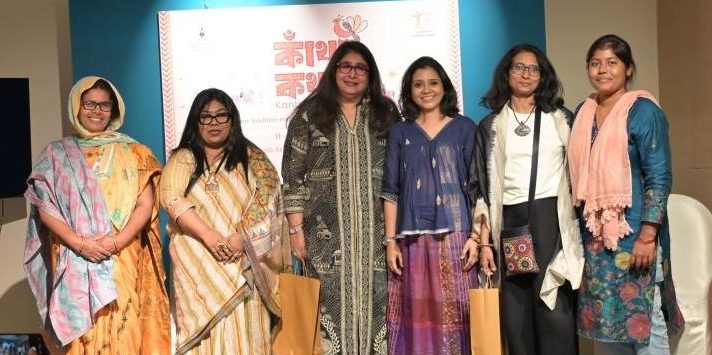
Sunita Shanker, founder of Sunita Shanker Studio, has worked across India’s craft regions for three decades. Her perspective shifted after working in Kutch following the 2001 earthquake, a move she described as one “from subtlety to bloom, to a certain gentle rhythm to vibrancy, to wet to arid.” On commercial viability, she spoke about a single-motif approach. Traditional kantha, dense with stitching across the whole textile, can take months to finish, and the price reflects it. In her approach, isolating one motif on a garment shortens production and brings prices down for everyday wear, and “With that single motif, what happened is that it not only enhanced the craft, but it also upskilled the artisan,” she explained, since a single visible motif leaves no room for error. Comparing the clusters she works with, she found Barasat “quicker, faster, and they’re a little more commercial,” while Nanoor’s artisans have a “big, large vocabulary” of stitches and a deep, personal attachment to their work.
Paromita Banerjee, founder and director of Paromita Banerjee Studio, trained in textiles at NID and has run her Kolkata label for fifteen years. She described her practice as sitting at the “intersection of art, craft, culture, and design,” with craft communities as its foundation, and spoke of taking rooted handlooms into a “global-local context.” She drew on two Japanese ideas: boro, the use of things too good to waste, and mottainai, a kind of regret over wastefulness. Both find an old parallel in layering worn saris instead of throwing them away. For her, this shifts the conversation from recycling to “emotional textiles,” and raises the question of how kantha might move into ready-to-wear without losing its identity.
Malika Dudeja Varma, co-founder and director of SHE (Self Help Enterprise) and director of Malika’s Kantha Collection, described a similar movement from tradition into livelihood. Her mother, Shamlu Dudeja, who arrived in Bengal from Karachi as a Partition refugee, started the enterprise about forty years ago by giving tea-dyed cotton saris to village women for stitching. What started as a revival of three-layer kantha has grown into a network of around 1,000 women who work from home, an economy of “dwar pe rozi.” “It has given financial empowerment. It has made every woman in her house have a say,” Malika remarked. The change shows in what women ask for — once they came for advances for a daughter’s wedding, “দিদি একটু টাকা দেবেন, আমার মেয়ের বিয়ে হবে”, and now they say, “দিদি টাকা দেবেন, আমার মেয়ে পড়বে, আমার মেয়ের কম্পিউটার চাই।”
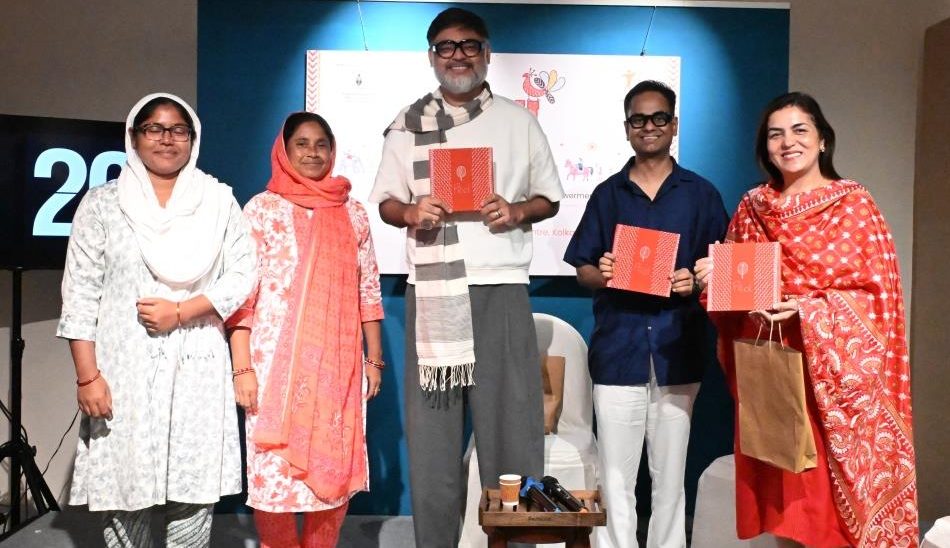
The conversation then turned to the artisans themselves. Loveli Bibi of Nanoor and Parveen Sultana of Ausgram, both Kantha artists and entrepreneurs, represent their collective Peol, named after a forest fruit that changes from green to red. Of the two, Loveli began at seven or eight, under her mother’s guidance. “তোর বিয়েতে লাগবে, তুই নিজের বিয়েতে নিজের কাঁথা নিজে কর,” her mother told her, warning that a bride who arrived without a kantha could be turned out of her in-laws’ house. Loveli resisted at first, but mastered the traditional S-fast style and later adapted her skills to items like stoles. Parveen, meanwhile, learnt to embroider in secret while still at school, and after she became a mother, a banglanatak.com workshop widened her sense of colour. “যে সবুজ, লাল, কালো বাদেও যে বাইরে অনেকগুলো কালার আছে, সে সম্পর্কে আমাদের অতটা আইডিয়া ছিল না,” she recalled.
Today both make contemporary pieces and work directly with designers and institutions. Their stories showed how design support, applied with care, can turn a household skill into a small enterprise and that it works best when the design leaves room for the artisan’s own skill and agency.
A Grammar for Space
“একটা মোটে ছেঁড়া কাঁথা, তার তলাতে আমরা ন’জন
কাঁথাটার ওপরটায় বেশ নকশা কাটা, সুতোয় তোলা ফুল ফুটেছে।”
— সুনীল গঙ্গোপাধ্যায়
On 15 September, the conversation moved from clothing to architecture, and Kantha in Contemporary Spaces was moderated by Anisha Johri, Partner at Decorage & Associates and Contours Furniture System. Her panel included Scenographer Swarup Dutta and Architect Ranit Maiti. Bina Dey, a National Award-winning Kantha artist, also took part, presenting her own work.
Swarup Dutta, founder and creative director of Swarup Dutta Scenography, has worked with the craft since 2004, and traces his own connection to watching his grandmother stitch at home, and through academic and development projects he has trained more than five thousand artisans. Addressing the history and nuances of stitch and design, he explained that traditionally, motifs reflected religious and cultural roots. “Figurative work is predominantly Hindu Kantha… because the nuances of religion do play into the craft,” he noted, adding that Muslim women traditionally created geometric patterns, and he laid out a rough history by stitch and design—kantha, built on the plain running stitch, is among the oldest forms, and includes nakshi kantha, with figures and narrative scenes, and par tola kantha, based on geometric pattern. There is also the tone-on-tone tradition, and sujani kantha which is closely tied to Rajshahi in Bangladesh and known for undulating floral and vine patterns, though sujni is also practised in Bihar.
He also pushed back on the common assumption that kantha only softens with age. Repeated use compresses its layers, and an old piece becomes “one solid, dense material.” That rigidity, he explained, means it can stand on its own, and the idea of kantha as a soft material is “a bit of a myth.” He added that aged Kantha is “as thick as sort of stitching leather,” opening up possibilities for heavy jackets, structural drapery, wall panels, or three-dimensional spatial forms.
Ranit Maiti, co-founder of Square Consultancy Services, described Kantha as a kind of design grammar. “For us, Kantha is a design grammar,” he observed, one built on repetition, layering, sustainability and visible labour. He cautioned against superficial borrowing: “The first thing which is most tempting is to identify the motifs… We see a lotus, we see a flower… and immediately we want to translate that into probably metal perforated screens.” His point was that designers must translate the rhythm and process, rather than just scaling up a pattern.
He also drew a distinction between two kinds of knowledge in India: the intergenerational knowledge held by artisans, and the formal knowledge taught in design schools. In collaborations, trained designers usually deal with clients and budgets, while craftspersons “come to the project at the end, the time of execution.” To make craft sustainable, artisans must be onboarded from the very beginning, he argued, so that they gain true co-authorship.
When Anisha Johri questioned how effectively Kantha has crossed over into interior design, Ranit described two ways his practice uses kantha: as an abstract spatial grammar, and as a functional material in screens, upholstery, wall panels, meeting rooms or ceilings. He offered possible applications—at the Six Ballygunge Place showroom, a heritage building, kantha or alpana-inspired screens could hide plumbing and air-conditioning lines, at Merlin Nia, near Ruby Hospital, water-ripple and chevron patterns could filter sunlight through a screen, in a luxury office in Alipore, large panels might work as soft art objects, and at a Ganges-facing project in Konnagar, the logic of the stitch could shape a ceiling that suggests river waves, while dense kantha fabric could also serve as an acoustic material in auditoriums. Here, the craft is a source of ideas for solving spatial problems, not a decoration added afterwards.
The conversation then turned to AI, where one concern was deskilling, as digital generation spreads and centuries of physical skill begin to erode. Another view was that AI democratises visualisation, letting designers render complex interiors quickly for clients. As hyper-realistic imagery becomes easy to produce, it may lose its novelty, and value may return to time, labour and the human touch, much as analogue photography and high-end Swiss lithography came to be prized for their handmade qualities. Hand-stitched work may find new worth as a luxury niche, where the maker’s irregularity is part of what makes the object distinctive.
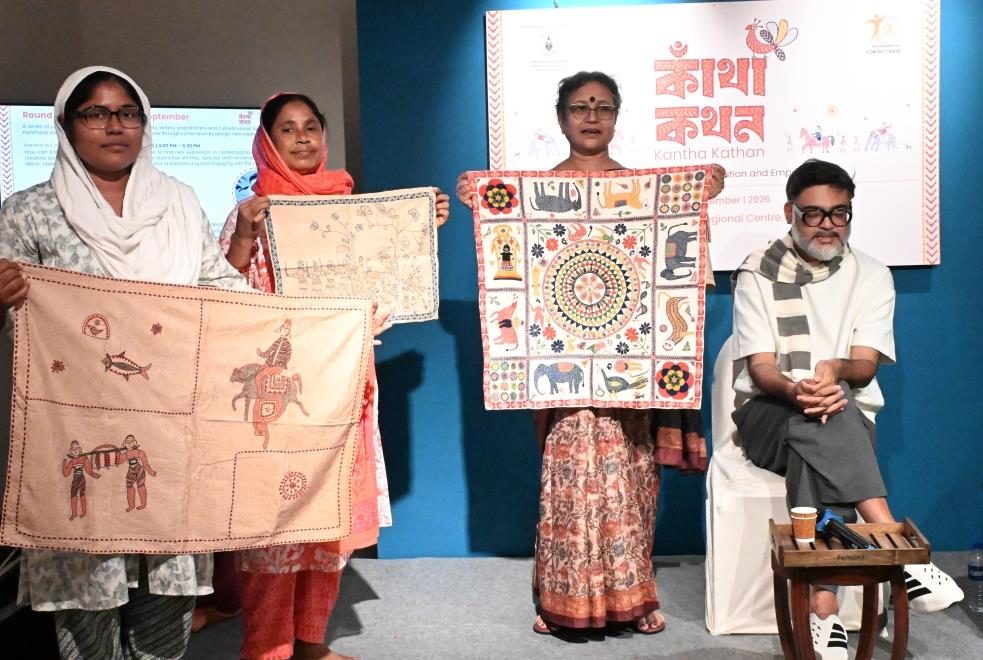
Bina Dey, associated with the Kantha Centre of the Crafts Council of West Bengal, grounded all this in history, presenting her own intricate Nakshi Kantha pieces alongside Colchas—the embroidered coverlets once produced in Satgaon for 16th- and 17th-century Portuguese trading markets. Her contribution made clear that Kantha’s dialogue with distant, global markets is not a recent phenomenon but a centuries-old one, grounded in a long-standing tradition where everyday utility and aesthetic value were inextricably linked. Whether made as a 17th-century export coverlet or used in a modern interior, Kantha bridges functional utility with art.
From Life to Motif
“নকশী-কাঁথাটি বিছাইয়া সাজু সারারাত আঁকে ছবি,
ও যেন তাহার গোপন ব্যথার বিরহিয়া এক কবি।
অনেক সুখের দুঃখের স্মৃতি ওরি বুকে আছে লেখা,
তার জীবনের ইতিহাসখানি কহিছে রেখায় রেখা”
— জসীম উদ্দিন
On 16 September, the final afternoon looked at where designs come from, and Finding Inspiration for Design was moderated by Esha Dutta, Director of Priya Entertainments (P) Ltd., an arts administrator long involved in cultural organising in the region. She spoke of her early experiments designing children’s furniture, and of a government-backed textile revival she had observed in the Northeast. Good design, she suggested, rests on aesthetic appeal and function. “If there’s no function… design kind of loses its purpose to a certain extent.” Kantha’s appeal lies in familiarity, as its motifs come from things seen and remembered, such as men working the fields, elephants and tigers, fish and turtles, soldiers, musicians, lotuses, crops, even steam engines and railway carriages. “I think Kantha is that one form of embroidery where everyday life and a bit of ourselves is embedded.”
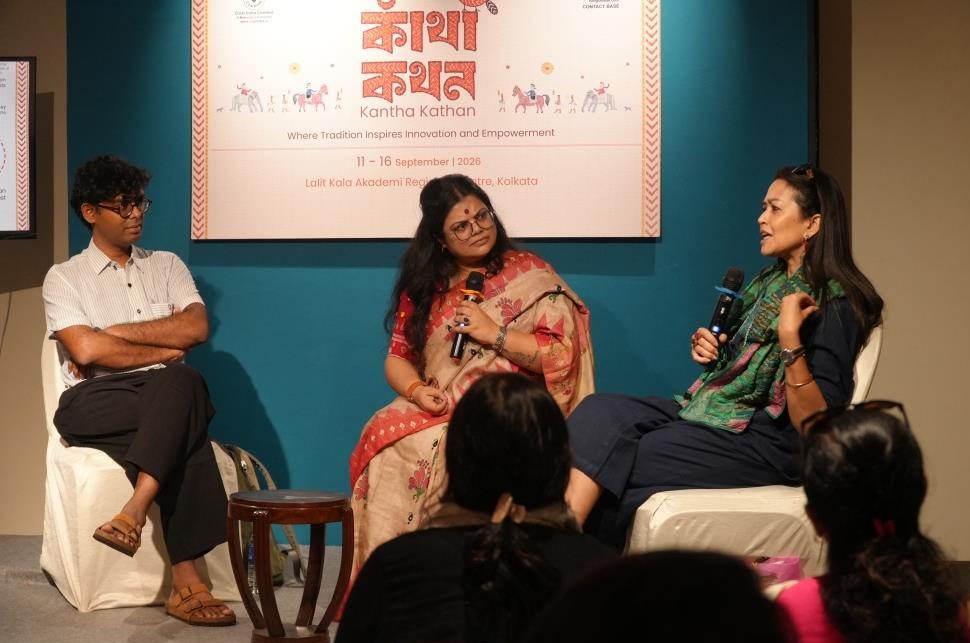
Parama Ganguly, designer and founder of Brand Parama, left a decade of legal practice to start her own label. Her first motifs came from her commute to the Calcutta High Court, where flowering palash trees gave her the earliest designs, followed by aparajita, joba and shiuli. Her father told her, “যদি রোজকার জিনিস থেকে ইন্সপায়ার্ড হও, তাহলে ইন্সপিরেশন আলাদা করে খোঁজার দরকার নেই. মানে ডাল-ভাত দেখে যদি ভালো লাগে, তাহলে রোজ পোলাও খাওয়ার দরকার নেই।” She traced her practice back to her great-grandmother, who pulled threads from worn sari borders to stitch quilts long before sustainability had a name. Working in new, commercially produced fabrics, she said, does not mean abandoning that history. “I realized people want to wear something that tells a story.” For her, “emotional connection is what design and inspiration are ultimately about.” She also spoke of dignity: “Dignity comes when artisans see their work being respected and recognized, not just as cheap labor, but as artistic mastery.” When a customer understands the labour behind every stitch, she said, they are willing to pay the right price, and that directly changes the artisan’s life.
Santanu Das, director of Maku Textile Private Limited and founder of the slow-fibre initiative Maku Textiles, argued that craft is a social identity, not a look that can simply be updated. “The craft is not visual. The craft is the handling of the material, the craft is how we process the material, the craft is the socio aspect of the material.” He also stressed its geographical identity, and warned that market pressure and social media, left unchecked, can wear down regional identity, as pop-culture motifs begin to appear on kantha quilts. “If you change the core, you destroy the craft. If you change the application, like turning a Kantha quilt into a jacket, or a lampshade, or a contemporary wall art piece, you are actually giving the craft a new lease on life.” He called on design institutions to work with artisan communities directly, rather than documenting them from a distance.
Today’s buyer, he noted, is different from the grandmother stitching a soft blanket from old saris. The market answers to instant gratification, a garment bought for one photograph and set aside, and that has fed a rise in machine-embroidered imitations, including in places like Santiniketan, which look handmade at a fraction of the cost and speed and put real pressure on those working by hand. “The problem happens when we compromise on the process itself… That is where the dilution happens, and that is what we must educate consumers and creators about.”
He also offered a way to look at unevenness: the Japanese appreciation for handmade textiles and natural irregularity, prominent in design discourse in the 1980s and 1990s, gives one lens on kantha beyond decoration. In kantha, however, unevenness is not simply an aesthetic choice; it comes from the act of stitching, the reuse of old cloth and the accumulated labour of the maker. What is admired as an aesthetic of imperfection elsewhere is, here, a record of use, care and everyday practice.
One practical difficulty surfaced as well: many rural artisans are not comfortable drawing or tracing complex patterns, so detailed design sheets are hard to transfer onto cloth and slow the work. Yet one answer lies close to home—local schoolgirls who can draw might work with fine arts students to form small drafting teams within a cluster, one preparing the drawing, another handling colour, the artisans doing the stitching, so that a production bottleneck becomes a shared local effort.
What Carries the Craft Forward
Kantha began inside the home, stitched in the hours left over after the day’s work. Through skill training, capacity building and design support, it has become a livelihood for more than two thousand practitioners in Birbhum and Purba Bardhaman, in clusters that include Nanoor and Ausgram.
The conversations did not settle on a single answer about where the craft is headed. What they offered was a view of how it is changing, through fashion, architecture, new materials and new kinds of collaboration. The real question is not whether kantha should stay the same, but how it can adapt without losing the knowledge, labour and identity that have carried it this far. At the centre are the artisans, whose skill has moved kantha from the household into new spaces without cutting its thread back to where it began.
–By Saionee Panja