“শুরুও শূন্যে, শেষও শূন্যে
আর মাঝপথটা
বিলাপে বিলাপে ভরা, চমৎকার এক ভাসমান নকশিকাঁথা
পরতে পরতে বুনে যাওয়া।”
— শঙ্খ ঘোষ
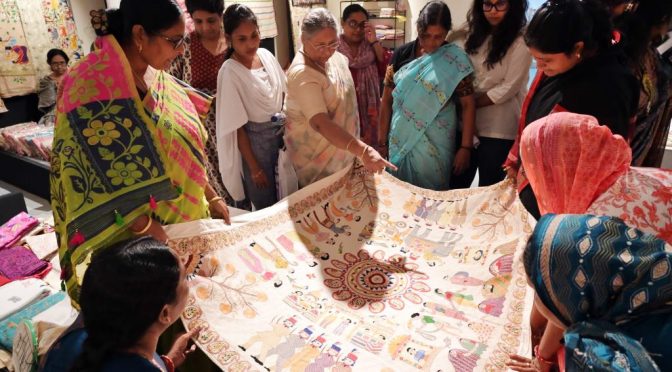
Kantha is one of the oldest textile traditions of eastern India. Babies were once wrapped in it; when a daughter married, it was passed down to her, carrying years of memory with it. The stitch at its heart is simple: the running stitch, the plainest stitch in embroidery’s vocabulary. It is the arrangement of that one stitch, repeated and varied, that builds kantha’s complex language. Traditionally a utilitarian craft, made from cloth already worn out and set aside, kantha has always found a way to mark the events of a life even as it served a practical need.
At the Lalit Kala Akademi Regional Centre, the exhibition, Kantha Kathan, looked at this tradition and at how it has evolved overtime, creating new opportunities for income and enterprise. The rich showcase of kantha made by 16 rural women entrepreneurs from Nanoor and Ausgram offered visitors a chance to see the work closely and understand the process behind it.
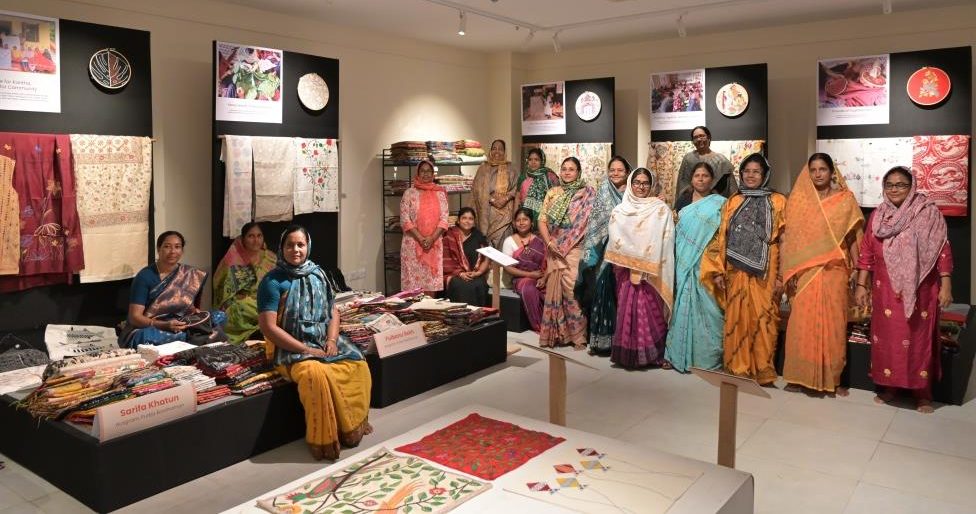
The exhibition also made space for memory. Under Threads of Memory, students shared photographs of treasured kantha quilts, saris, coverlets, and other textiles preserved in their families and passed down through generations, along with the stories attached to them. Each submission became a bridge between generations, carrying the emotions, traditions, and memories woven into kantha.
Alongside the exhibition, conversations and workshops explored different aspects of the tradition. Titled “Kantha: Woven Words,” the discussion on 12 September brought together Mrityunjay Kumar Singh, Sudeshna Moitra, and Chandrima Roy, each approaching kantha from a different perspective: as literature, as story, as an early form of what we would now call sustainability. Between them, they explored kantha through craft, storytelling, and cultural memory, considering the quilt as a form of unwritten autobiography, a means of passing knowledge through stories, and a way of thinking about dialogue, continuity, and reuse.
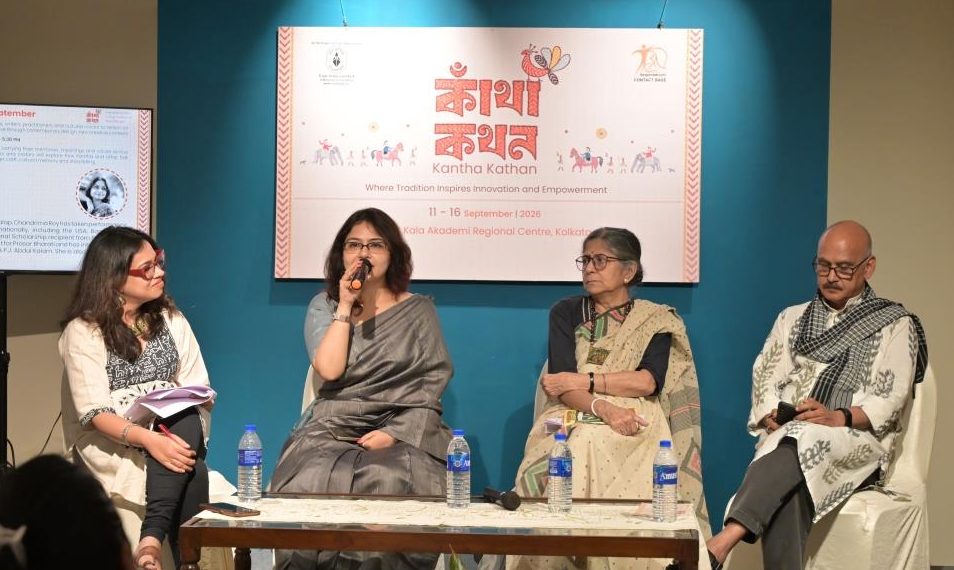
The evening opened with the discussion on various literary references in which weaving or embroidery appears across various ancient literature to contemporary works. In the Iliad, Helen sits weaving scenes of the war fought over her, turning the cloth into a record of events she cannot otherwise narrate. In the Odyssey, Penelope weaves and unweaves Laertes’ shroud night after night, buying herself time against a remarriage she does not want. In both, the loom becomes a way for women through which they shape and preserve their own narratives.
Indian literature carries the same thread. Kantha recurs through Rabindranath Tagore’s work, appearing in the story Kripon, where a woman clutches her kantha as her son leaves, the cloth standing in for a life already unravelling. In the folk collection Thakurmar Jhuli, Kantha-buri, the Old Quilt-Lady, spends her days sewing. The tradition surfaces again in Shankha Ghosh’s poetry, in Mahasweta Devi’s fiction, and in Ashapurna Devi’s Subarnalata, where the unsettled young bride keeps stitching her quilt as a way of holding on to herself inside her in-laws’ house.
The Needle in Place of the Pen
Mrityunjay Kumar Singh, Director of Bharatiya Vidya Bhavan, Kolkata, a retired IPS officer, while also a published poet, writer, and Bhojpuri folk vocalist, opened with the idea of ekphrasis, writing that describes or responds to a visual work. Embroidery has always given literature something to look at and describe, and in Bengali literature one of the best known example is Jasimuddin’s 1929 pastoral masterpiece, Nakshi Kanthar Math uses the kantha as a symbol of a woman’s grief and her waiting.
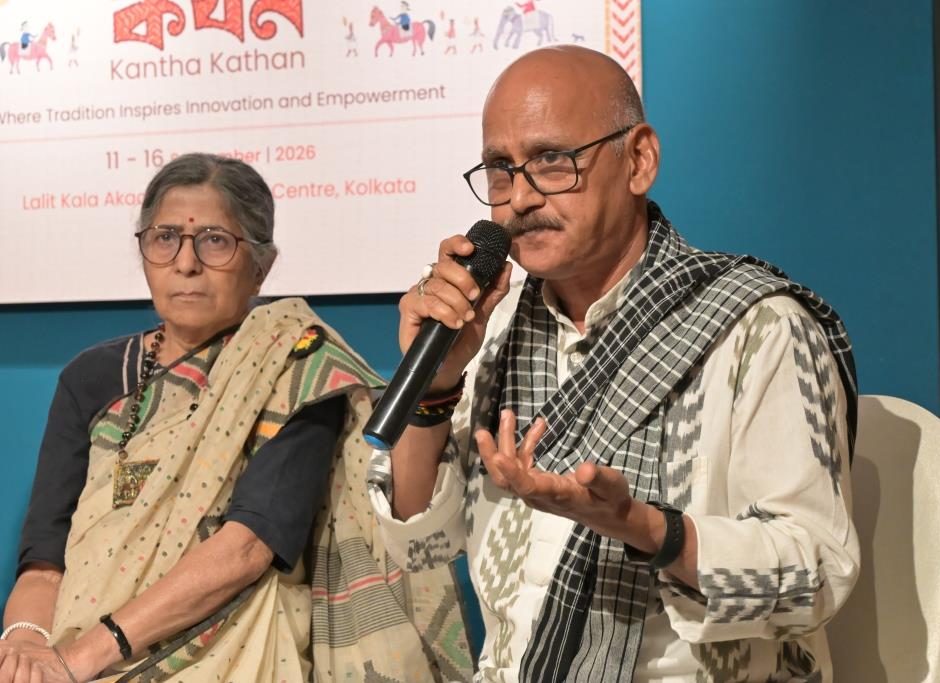
Mrityunjay’s real subject was what that symbol stood in for. For centuries, rural women were kept from formal education and from “the world of words.” However, a lack of formal literacy did not mean an absence of narrative capability. Deprived of pen and ink, they turned to needle, thread, the running stitch, and song to record experiences that were often autobiographical. He told the story at the centre of Jasimuddin’s poem: Saju, married to Rupai, a farmer known for his flute and his skill with a fighting stick, is left behind when a land dispute pulls her husband into a fight that keeps him away for months. Waiting, she stitches into her kantha what she has no other way of preserving: the flowers from the day they met, the wedding, the ordinary life they built. The quilt becomes the only surviving account of it. Jasimuddin gives this image a larger place at the close of the poem:
“কেহ কেহ নাকি গভীর রাত্রে দেখেছে মাঠের পরে / মহা-শূন্যেতে উড়াইছে কেবা নকসী কাঁথাটি ধরে।”
The kantha has become more than a record of Saju’s life; it has entered the landscape of the poem itself.
Drawing parallels to folk traditions across Northern and Eastern India—such as Bihar’s Sujani quilting, Gujarat’s Mata ni Pachedi, Rajasthan’s Phad, Odisha’s Pattachitra, Bhojpuri Janta Saar (grinding stone) songs, and Biraha ballads—Mrityunjay highlighted how women embedded their personal heartbreaks, social anxieties, and quiet resilience into everyday objects, “What did women do when they did not have words? They sang, embroidered, and stitched… these artworks are basically a kind of autobiography of those women who could not write their stories.”
Across all of them, he saw the same practice: making, remembering, and speaking through whatever material was to hand. In this sense, the act of stitching kantha could itself become an exercise in female agency.
The Stories in the Stitch
Sudeshna Moitra, known to generations of children as Golpo Dida, the storytelling grandmother, is a writer and a former teacher. She began with the word itself: kantha may descend from kontha, the Sanskrit word for rags, which appears across medieval Bengali texts. In Krishnadasa Kaviraja’s, the mother of Chaitanya Mahaprabhu sends her son a homemade kantha by way of travelling pilgrims. In Bharatchandra Ray Gunakar’s Annadamangal (1752–53), the kantha appears in the description of the goddess Annapurna and Shiva, alongside the humble objects associated with their lives:
“ঝুলি কাঁথা বাঘছাল সাপ সিদ্ধি লাড়ু॥”
The reference places the kantha alongside the ordinary things of daily life, where its use is practical rather than ornamental.
Lalon Fakir’s songs carry the word too, in “আয় দেখে যা নতুন ভাব এনেছে গোরা।মুড়িয়ে মাথা গলে কাঁথা কটিতে কৌপীন পরা॥” Gauranga is described with a kantha around his neck, tied to the life of the renunciant.
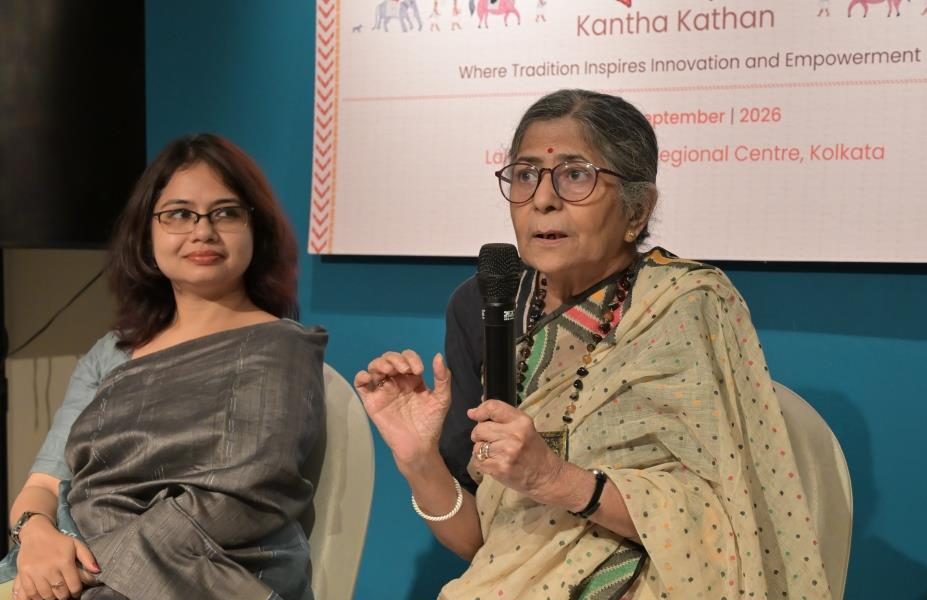
Golpo Dida noted how deeply rooted this practice was in Bengali households, “আমাদের বাংলার ঘরে ঘরে মেয়েরা তাদের সময় কাটানোর জন্য এই কাঁথাটা ফোঁড়টা দিত, এই রান-সেলাইটা করত। এবং এখানে অনেকেই তার সুখ-দুঃখের কথা, অনেককিছুই বলেছে।” She then told a story of her own devising: three children meet an old woman they call Kantha Dida, who shows them how women once drew threads from the borders of worn saris to stitch nakshi kantha, the narrative pattern-work, and explains the quilt’s ordinary place in rural households, where it is also called kyata. Through the story, the children come to see the kantha as something that holds affection, history, and memory. Kantha Dida tells them how the craft surfaces again and again in medieval writing: a kontha “washed and put out to dry” in Chaitanya Charitamrita, Chaitanya wearing one after renouncing wealth in Chaitanya Bhagavata, and its presence in Chandrabati’s Ramayana.
For Golpo Dida, the word kothon (telling, or dialogue) in the title of the series names exactly what kantha is: something made by stitching and by talking at once, carrying a family’s memory from one generation into the next.
From Cloth to Continuity
“গায়ে ছিল এক ছেঁড়া কাঁথা…
তোখন লয়লে কলেমা পড়ে ঝাড়ি মাথা।”
— জসীমউদ্দীন, সোজন বাদিয়ার ঘাট
Chandrima Roy closed the evening, arriving from an unlikely pairing of work: she teaches Electronics and Communication Engineering and also runs Kobitay Kathalap, a poetry initiative marking its fourteenth year on the evening of the talk. Drawing on Bloom’s Taxonomy and on her own years in education, she noted that in an age of fast-moving information, facts fade quickly, while “গল্প মানুষের সবসময় মনে থাকে।”
She offered a second possible root for the word: kaththa, from Prakrit. Long before “sustainability” or “circular economy” entered common use, she said, kantha was already a working model of both: old cotton saris bound with bright border-thread, stitched with the running stitch, ran selaai, into something durable and, in its way, beautiful.
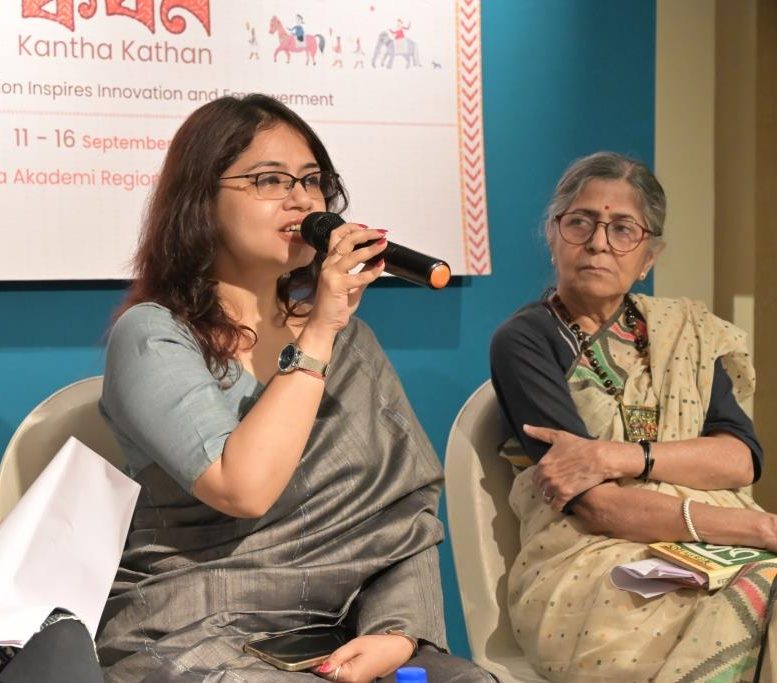
Beyond the material, she argued, kantha offered emotional repair, a comfort she likened to a mother’s anchal, the drape of a sari pulled close. She recalled Premchand’s regard for his own mother, who ran a household on almost nothing, and Tagore’s poem Nimantran, with its image of a damp, embroidered handkerchief. Where women had little access to education or to public life, sitting together to stitch made a space to talk, to grieve, to lighten a burden: the same quiet concentration that modern therapeutic practice now recognises as genuinely calming.
Reflecting on the layering of speech and stitch, she observed—”একটি পর একটি ফোঁড় তুলে যেমন কাঁথার নকশা বোনা হয়, ঠিক তেমনই কথার ভাঁজে কথা সাজিয়ে কিন্তু মানুষের জীবন, সময়, সমাজ তার একটা প্রবাহমানতা তৈরি হয়।” Kantha, she said, has always done more than hold a design or a livelihood; it holds a story and, often, comfort along with it. In Rajshahi it is still given as a wedding gift. In Chittagong, brides leaving for other countries carry kanthas made by their mothers and grandmothers: a way of taking family and home along with them.
The Craft That Still Carries
Taken together, the evening’s three readings of kantha were less in competition than in conversation, each completing something the others left unsaid.
The tradition is not only historical. In Nanoor and Ausgram, kantha has also become a pathway to livelihood, entrepreneurship, and greater independence. Women artists are moving beyond wage-based work to manage orders, develop products, and work with designers and institutions. Their collective, Peol, brings inherited kantha knowledge into contemporary products and markets, while younger practitioners continue the craft alongside higher education.
The Kantha Skill Development Centre in Agartor, Nanoor, established with CSR support from Coal India Limited, provides space for skill development, new products, and entrepreneurial opportunities. More than two thousand women across Birbhum and Purba Bardhaman now work with Contact Base through such initiatives. Taking cloth that might otherwise be discarded and turning it into memory, livelihood, and a means of carrying life forward: that, in essence, was the evening’s central theme.
– By Saionee Panja